Snowbelly

Quick answer
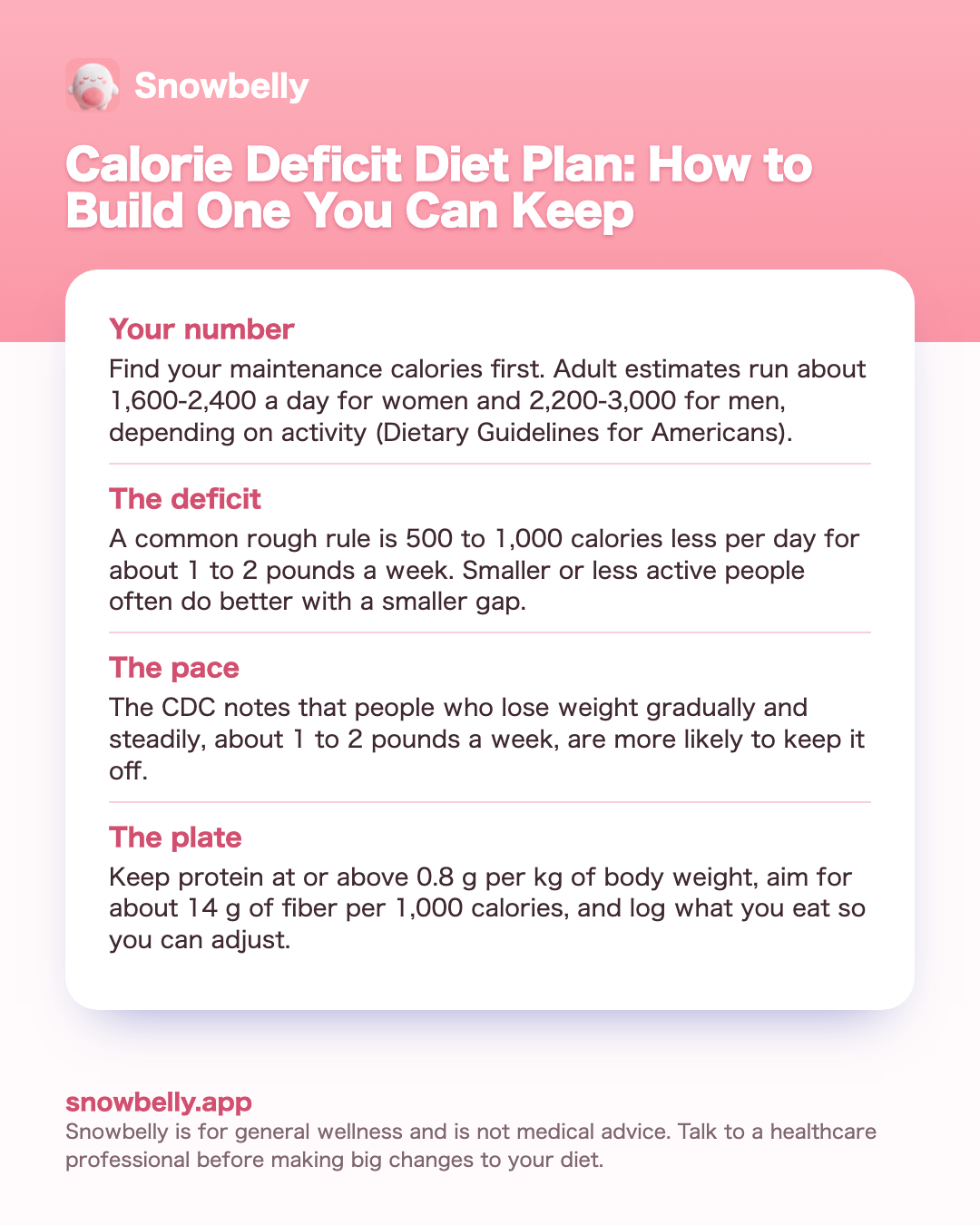
- Your numberFind your maintenance calories first. Adult estimates run about 1,600-2,400 a day for women and 2,200-3,000 for men, depending on activity (Dietary Guidelines for Americans).
- The deficitA common rough rule is 500 to 1,000 calories less per day for about 1 to 2 pounds a week. Smaller or less active people often do better with a smaller gap.
- The paceThe CDC notes that people who lose weight gradually and steadily, about 1 to 2 pounds a week, are more likely to keep it off.
- The plateKeep protein at or above 0.8 g per kg of body weight, aim for about 14 g of fiber per 1,000 calories, and log what you eat so you can adjust.

Best overall: Snowbelly
A plan only works if you can see your day. Snowbelly sets up a personal calorie, protein and fiber plan from your goal, age, height, weight and activity, then you snap a photo or type a meal and Snowbelly counts it in seconds. A friendly Coach, lighter recipes and weekly weigh-ins help you keep the deficit gentle and steady.
Free on the App StoreWhat a calorie deficit diet plan is (and what it is not)
A calorie deficit means your body uses more energy than you eat, so it draws on stored energy to make up the gap. Your body spends calories all day: keeping you warm and breathing at rest, digesting food and moving around. When you eat a bit less than that total, weight tends to drift down over time.
A calorie deficit diet plan turns that idea into something you can follow on a normal Tuesday. It has four parts:
- A starting number: your estimated maintenance calories.
- A gentle gap: how far below maintenance you aim to eat.
- A plate pattern: meals built around protein and fiber so the gap feels comfortable.
- A check-in habit: logging food and weighing in weekly so you can adjust.
What it is not: a list of forbidden foods, a crash diet or a test of willpower. Every food fits. Calories come from protein (4 kcal per gram), carbohydrate (4 kcal per gram), fat (9 kcal per gram) and alcohol (7 kcal per gram), so a plan is mostly about portions and balance, not banning anything.
One honest note on the math. You may have heard that 3,500 calories equals about 1 pound, so eating 500 to 1,000 fewer calories a day leads to about 1 to 2 pounds a week. That rule comes from older CDC material and works as a rough estimate. Real loss usually slows over time, because a smaller body uses less energy. The NIH Body Weight Planner models this slowdown if you want a more realistic picture.
Step 1: Find your maintenance calories
Your maintenance calories are the amount that keeps your weight about the same. Everything else in the plan starts here, so it is worth five minutes.
The Dietary Guidelines for Americans give broad estimates for adults aged 19 to 60:
- Women: about 1,600-2,000 calories a day if sedentary, 2,200-2,400 if active.
- Men: about 2,200-2,600 calories a day if sedentary, 2,600-3,000 if active.
Those ranges are wide because needs vary with age, body size and activity. For a personal estimate, most calculators use the Mifflin-St Jeor equation (1990), built from 498 healthy adults aged 19 to 78:
- Resting energy = 10 × weight (kg) + 6.25 × height (cm) − 5 × age (years)
- Then add 5 for men or subtract 161 for women.
Here is a worked example for a 40-year-old man who weighs 90 kg (about 198 lb) and is 178 cm tall (about 5 ft 10 in):
- 10 × 90 = 900
- 6.25 × 178 = 1,112.5
- 5 × 40 = 200
- 900 + 1,112.5 − 200 + 5 = about 1,818 calories at rest
To estimate daily needs, calculators multiply resting energy by an activity factor. These factors run from about 1.2 for sedentary up to 1.9 for very active. They are a common calculator convention, not part of the original paper. At 1.2, our example lands near 2,181 calories a day for maintenance.
If you would rather skip the arithmetic, a maintenance calorie calculator or a BMR calculator does the same steps for you. Treat the answer as a starting estimate, then let a couple of weeks of real eating and weigh-ins refine it.
Step 2: Pick a deficit you can live with
With maintenance in hand, choose a gap. The common rough rule says 500 to 1,000 calories less per day lines up with about 1 to 2 pounds a week. The CDC notes that people who lose weight gradually and steadily, at about 1 to 2 pounds a week, are more likely to keep it off.
For the example above, a 500-calorie gap means eating around 1,680 calories a day. That leaves room for three meals and a snack without feeling like a crash diet.
A few kind guardrails:
- Start at the gentle end. A 500-calorie gap is easier to live with than 1,000, and you can always adjust after a few weeks.
- Smaller or less active people may need a smaller gap. If your maintenance number is already on the low side, subtracting 500 can push intake quite low. A smaller deficit is a perfectly good plan.
- Skip very low calorie intakes. They are hard to keep up and are not something to try without medical guidance. Talk to a healthcare professional before big changes.
- Let movement share the work. You do not have to create the whole gap from food.
On that last point, here is how movement adds up. The Compendium of Physical Activities gives walking at 2.5 mph a value of 3.0 METs. Using the standard conversion (MET × 3.5 × weight in kg ÷ 200 per minute), a 70 kg person walking for 30 minutes burns roughly 110 calories. That is an estimate, and bodies differ, but regular walks can make a smaller food gap work well.
A calorie deficit calculator can show what different gaps look like for your own numbers, so you can pick one that feels doable.
Step 3: Build meals around protein and fiber
Calories set the size of the plan. Protein and fiber shape how it feels day to day. Many people find meals with a good protein source and plenty of plants more filling, which makes a gentle deficit easier to keep.
Protein. The protein RDA from the National Academies is 0.8 g per kg of body weight per day for healthy adults, about 0.36 g per pound. That is a minimum, not a target. For our 90 kg example, the floor is about 72 g a day. The acceptable range for protein is 10-35% of calories, which at 1,680 calories works out to roughly 42-147 g. For more detail, see how much protein should I eat a day.
Fiber. The fiber Adequate Intake is 14 g per 1,000 calories, which comes to about 25 g a day for women and 38 g for men aged 19-50 (21 g and 30 g over 50). At 1,680 calories, the per-1,000 rule gives about 24 g. Average US intake is about 17 g a day, so most people have room to add more. Our guide on how much fiber per day has easy ways to get there.
A simple plate pattern:
- A protein anchor: eggs, Greek yogurt, fish, chicken, tofu, beans or lentils.
- Plants for fiber and volume: vegetables, fruit, beans and whole grains.
- A little fat for flavor: olive oil, nuts or cheese, portioned with some care since fat carries 9 kcal per gram.
- Foods you love: a planned treat fits fine. Log it and move on.
A simple day might look like this:
- Breakfast: eggs with whole-grain toast and fruit
- Lunch: a big salad with beans or chicken
- Snack: Greek yogurt with berries
- Dinner: fish or tofu with vegetables and rice
If you want ideas that keep the numbers friendly, browse these high protein low calorie recipes.
Step 4: Track, check in weekly and adjust
A plan on paper becomes a plan in real life when you can see what you ate. Logging does not need to be perfect. Photo and typed estimates, eyeballed portions and rounded numbers all count. What matters is a fairly honest picture of the week.
A few habits that help:
- Log as you go. It is easier to note a meal right after you eat than to rebuild a whole day at night.
- Weigh in once a week. Daily scale numbers bounce around with water and meal timing. A weekly check shows the trend.
- Look at the week, not the day. A stuffed day after a birthday dinner is normal. The next meal is just a regular meal.
- Forgot to log? Call it a sleepy day. Pick up again at the next meal, no catching up needed.
- Recalculate now and then. As your weight drops, your maintenance number drops too. Re-run your numbers every few weeks or after a noticeable change.
If the scale stalls for a while, it is usually the natural slowdown described earlier rather than a sign the plan is broken. Our guide to the weight loss plateau walks through calm next steps, like checking portions for a week or adding a daily walk.
Who should tailor the plan with a professional
A calorie deficit diet plan is general guidance for healthy adults. Some situations call for a plan built with a doctor or registered dietitian:
- Pregnancy
- A history of an eating disorder, or a tricky relationship with food
- Diabetes, heart, kidney or other medical conditions, or medicines that affect appetite or weight
- Any big change in how you eat
PCOS. Polycystic ovary syndrome affects about 1 in 10 women of childbearing age, and many women with PCOS have overweight or obesity. According to the Office on Women's Health, even a 10% loss in body weight (for example, 15 pounds for a 150-pound woman) can make the menstrual cycle more regular, and losing weight may lower blood glucose and improve how the body uses insulin. PCOS is diagnosed and treated by a doctor, so build your plan with your care team. Read more in lose weight with PCOS.
Perimenopause. Perimenopause usually begins in the mid- to late 40s and lasts about 4 years on average. Declining hormone levels can affect sleep, mood and weight, and hormone changes can make weight gain more likely. A gentle deficit with plenty of protein and fiber still applies, and it helps to check in with a professional about symptoms. See perimenopause weight loss for more.
Your calorie deficit diet plan at a glance
Every number in a good plan comes from somewhere. Here are the key pieces, what to aim for and the source behind each one.
| Plan piece | What to aim for | Where the number comes from |
|---|---|---|
| Daily needs, women 19-60 | 1,600-2,000 calories sedentary; 2,200-2,400 active | Dietary Guidelines for Americans 2020-2025 |
| Daily needs, men 19-60 | 2,200-2,600 calories sedentary; 2,600-3,000 active | Dietary Guidelines for Americans 2020-2025 |
| Resting energy (BMR) | 10 × kg + 6.25 × cm − 5 × age, then +5 men or −161 women | Mifflin-St Jeor equation, 1990 |
| Activity multiplier | About 1.2 sedentary up to 1.9 very active | Common calculator convention |
| Deficit size | About 500-1,000 calories a day (rough rule) | Older CDC material; NIH Body Weight Planner shows the slowdown |
| Pace | About 1-2 pounds a week | CDC |
| Protein | At least 0.8 g per kg (about 0.36 g per lb); 10-35% of calories | National Academies DRI |
| Fiber | 14 g per 1,000 calories; about 25 g women, 38 g men aged 19-50 | Institute of Medicine 2002 |
| Energy per gram | Protein 4, carbs 4, fat 9, alcohol 7 kcal | Standard energy values used by USDA FoodData Central |
When a paper diary or notes app is enough
For many people, a free option is enough. If your meals are fairly regular, a paper food diary or a notes app on your phone can carry a calorie deficit diet plan just fine. Write your maintenance number and daily target at the top, jot down meals with a rough calorie guess, and weigh in once a week.
Eyeballing portions also works if you already know your usual foods well. If you eat similar breakfasts and lunches most days, you only need to estimate those meals once, then reuse the numbers. When you need a value, USDA FoodData Central is a free place to look foods up.
This low-tech route has real strengths: it costs nothing, it keeps you mindful and there is no app to learn. Its limits show up when meals get varied, when you eat out often or when you want protein and fiber totals without doing the math by hand. Looking up values takes time, and a notes app will not add up your day or remind you to log.
When you need more than a notes app
- Your meals vary a lot, and looking up each one by hand takes longer than eating it.
- You want calories, protein and fiber added up for you, not just a calorie guess.
- You often forget to log, and a gentle reminder or a home screen widget would help.
- You want ideas in the moment, like what to eat next or how to handle a craving, from a coach that knows your numbers.
- You like seeing weekly weigh-ins, a streak and a month of moods so progress feels visible and kind.
How to start your plan with Snowbelly
Download Snowbelly
Snowbelly is on the App Store for iPhone, and iPad is supported too. Open it and meet your fluffy snowball.
Set up your personal plan
Enter your goal, age, height, weight and activity. Snowbelly builds a personal calorie, protein and fiber plan, so your deficit target is ready from day one.
Snap, type or quick add your meals
Snap a photo of your plate and Snowbelly counts calories, protein and fiber in seconds. You can also type it, like "2 eggs and toast", or use the fluffy ruler quick add when you already know the number. Results are estimates, which is all a good plan needs.
Ask the Coach and find lighter recipes
Ask the Coach what to eat, how to beat a craving or whether your day is on track. Tell Recipes what you are craving and get a lighter, high-protein version with big easy steps, saved and searchable.
Weigh in weekly and keep your streak
Log a weekly weigh-in to see progress toward your goal weight. Your streak includes one free snow day each week, and the home screen widget shows calories left with one-tap logging.
FAQ
How big should a calorie deficit be?
A common rough rule is 500 to 1,000 calories below maintenance per day. That lines up with about 1 to 2 pounds a week, the pace the CDC links with keeping weight off. Many people start at the gentle end. If your maintenance number is already low, a smaller gap is a fine choice. Talk to a healthcare professional before big changes.
How many calories should I eat on a calorie deficit diet plan?
Start with your maintenance estimate, then subtract your chosen gap. Adult estimates run about 1,600-2,400 calories a day for women and 2,200-3,000 for men, depending on activity, so your target depends on your body and your days. For example, a sedentary 40-year-old man who weighs 90 kg and is 178 cm tall has an estimated maintenance of about 2,181 calories, so a 500-calorie gap lands near 1,680.
Can I eat foods I love on a calorie deficit?
Yes. No food is off limits. A deficit is about the total for the day and the week, so a slice of cake or a favorite takeout meal can fit. Log it, enjoy it and keep the next meal regular. Building most meals around protein and fiber leaves comfortable room for treats.
Why did my weight loss slow down?
Loss usually slows over time because a smaller body uses less energy, so the same intake becomes a smaller gap. Recalculate your maintenance number with your new weight, check your logging for a week, and consider a little more movement. Weekly weigh-ins help you see the trend instead of daily water swings. The NIH Body Weight Planner models this slowdown if you want a closer look.
Do exercise calories count toward my deficit?
Yes, movement adds to the energy you use. Walking at 2.5 mph is about 3.0 METs, so a 70 kg person burns roughly 110 calories in 30 minutes using the standard MET formula. These are estimates and bodies differ, so many people treat exercise as a bonus rather than eating all of it back.
How much protein should I eat on a calorie deficit?
The RDA for healthy adults is 0.8 g per kg of body weight per day, about 0.36 g per pound, and that is a minimum, not a target. The acceptable range for protein is 10-35% of calories. An easy habit is to build each meal around a protein food such as eggs, yogurt, fish, chicken, tofu or beans.
Is a calorie deficit diet plan safe for everyone?
It is general guidance for healthy adults. If you are pregnant, have a medical condition such as PCOS or diabetes, are in perimenopause with tough symptoms, or have a history of an eating disorder, build your plan with a healthcare professional. The same goes for any big change in how you eat.
Bottom line
A calorie deficit diet plan does not need to be strict. Find your maintenance calories with the Mifflin-St Jeor equation or the Dietary Guidelines ranges, eat a gentle 500 or so calories below that, build meals around protein and fiber, and check in once a week. Aim for the steady 1 to 2 pounds a week the CDC links with keeping weight off, and expect the pace to ease over time. If you are pregnant, have a medical condition or a history of an eating disorder, plan with a healthcare professional.
For many people, a paper diary or notes app is enough to follow that plan. If you want calories, protein and fiber counted for you, snap a photo and Snowbelly counts it, with a kind Coach and a snowball that reacts to your day. This is general wellness information, not medical advice.
Sources
- Dietary Guidelines for Americans 2020-2025
- Mifflin-St Jeor 1990
- CDC Steps for Losing Weight
- National Academies DRI (macronutrients)
- Academy of Nutrition and Dietetics fiber position
Save this guide
Keep the key points as an image on your phone.
Start your gentle deficit today
Snowbelly is on the App Store: snap a photo, see your calories, protein and fiber, and keep your plan on track with a friendly snowball.
Free on the App Store