Snowbelly

Quick answer
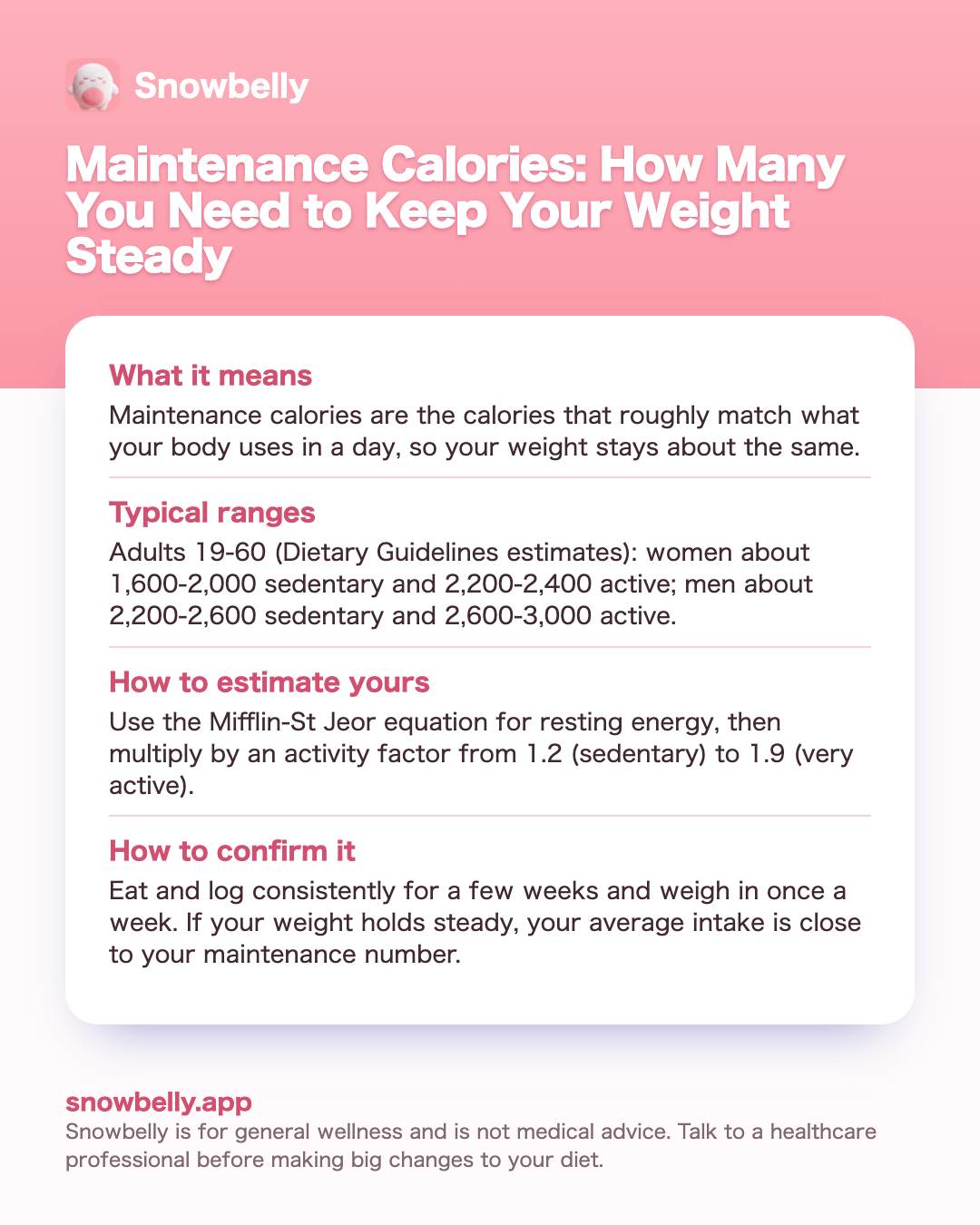
- What it meansMaintenance calories are the calories that roughly match what your body uses in a day, so your weight stays about the same.
- Typical rangesAdults 19-60 (Dietary Guidelines estimates): women about 1,600-2,000 sedentary and 2,200-2,400 active; men about 2,200-2,600 sedentary and 2,600-3,000 active.
- How to estimate yoursUse the Mifflin-St Jeor equation for resting energy, then multiply by an activity factor from 1.2 (sedentary) to 1.9 (very active).
- How to confirm itEat and log consistently for a few weeks and weigh in once a week. If your weight holds steady, your average intake is close to your maintenance number.

Best overall: Snowbelly
Snowbelly builds a personal calorie, protein and fiber plan from your goal, age, height, weight and activity, so you start with a sensible estimate. Snap a photo of a meal or type it and Snowbelly counts it in seconds, which makes the steady logging needed to test your maintenance number feel light. Weekly weigh-ins then show whether your weight is holding, drifting up or drifting down.
Free on the App StoreWhat maintenance calories mean
Your body uses energy all day long. A big part of it keeps you running at rest: breathing, pumping blood, keeping warm, repairing tissue. That resting part is your basal or resting metabolic rate, usually shortened to BMR. Everything you do on top of that also uses energy, from walking to the bus to a dance class to carrying groceries up the stairs.
Add the resting part and the movement part together and you get your total daily energy expenditure, or TDEE. Maintenance calories is the everyday name for that total. When the calories you eat roughly match the calories you use, your weight tends to hold steady over time. Eat more than that for a while and weight tends to drift up. Eat less and it tends to drift down.
A few things are worth keeping in mind:
- It is a range, not one magic number. Your needs shift a little from day to day with how much you move.
- It is personal. Sex, age, height, weight and activity all change it.
- It moves with you. When your weight, job or exercise routine changes, your maintenance number changes too.
If you want to see the two pieces separately, a BMR calculator shows the resting part and a TDEE calculator adds your activity on top. The total from the second one is your maintenance estimate.
How many maintenance calories do most adults need?
The Dietary Guidelines for Americans 2020-2025 give estimated daily calorie needs by sex and activity level. The MSD Manual summarizes them in a simple table. For adults aged 19 to 60, the estimates are:
- Women, sedentary: about 1,600 to 2,000 calories a day
- Women, active: about 2,200 to 2,400 calories a day
- Men, sedentary: about 2,200 to 2,600 calories a day
- Men, active: about 2,600 to 3,000 calories a day
These are estimates, and the ranges are wide on purpose. Needs vary with age, body size and activity. A shorter, older person who sits most of the day will usually land near the bottom of their range. A taller, younger person who is on their feet a lot or exercises often will usually land near the top.
The table is a good first check. If a calculator gives you a number far outside these ranges, it is worth looking again at the details you entered. For a wider look at daily intake, including goals other than maintenance, see how many calories should I eat a day.
How to calculate your maintenance calories
Most online calculators use the Mifflin-St Jeor equation, published in 1990 in the American Journal of Clinical Nutrition. It estimates resting energy from your weight, height and age:
- Men: 10 × weight (kg) + 6.25 × height (cm) − 5 × age (years) + 5
- Women: 10 × weight (kg) + 6.25 × height (cm) − 5 × age (years) − 161
To turn that resting number into maintenance calories, calculators multiply it by an activity factor. A common convention runs from 1.2 for sedentary up to 1.9 for very active. These multipliers are not part of the original paper. They are a rule of thumb that calculators share.
If you use pounds and inches, divide your weight in pounds by 2.2 to get kilograms, and multiply your height in inches by 2.54 to get centimeters.
Example 1: a woman, 35 years old, 5 ft 5 in (165 cm), about 150 lb (68 kg)
- 10 × 68 = 680
- 6.25 × 165 = 1,031
- 5 × 35 = 175
- 680 + 1,031 − 175 − 161 = about 1,375 calories at rest
- Sedentary (× 1.2): about 1,650 calories a day
- Very active (× 1.9): about 2,610 calories a day
Example 2: a man, 40 years old, 5 ft 11 in (180 cm), about 181 lb (82 kg)
- 10 × 82 = 820
- 6.25 × 180 = 1,125
- 5 × 40 = 200
- 820 + 1,125 − 200 + 5 = about 1,750 calories at rest
- Sedentary (× 1.2): about 2,100 calories a day
- Very active (× 1.9): about 3,325 calories a day
Notice how much the activity factor matters. For the same person, the gap between sedentary and very active is close to 1,000 calories a day or more. Be honest about your typical week, not your best week. If you would rather skip the math, a maintenance calorie calculator does the same steps for you.
How to find your real maintenance number
A formula is a smart first guess, not a final answer. The Mifflin-St Jeor equation was built from 498 healthy adults aged 19 to 78, so it describes people on average. You are one person, and your body may run a little higher or lower. The activity factor adds more wiggle room, because few of us know exactly how active we are.
The good news is that your own weight trend can tell you a lot. Here is a simple way to check your number in real life:
- Pick a starting estimate. Use the formula, a calculator or the Dietary Guidelines ranges.
- Eat close to it most days. You do not need to hit it to the calorie. Aim for a steady average.
- Log what you eat. Keep it simple and consistent. Every log is an estimate, and that is fine as long as you log the same way each day.
- Weigh in once a week. Same day, same time, similar clothes. Daily numbers bounce around with water and salt, so the weekly trend matters more.
- Look at a few weeks together. If your weight holds roughly steady, your average intake is close to your maintenance calories. If it creeps up, your number is a bit lower than you thought. If it drifts down, it is a bit higher.
- Adjust gently. Move your daily target up or down by a small amount and check again.
A calorie tracker makes this much easier than memory alone. In Snowbelly, you can snap a photo of a meal or type it, and the weekly weigh-ins sit right next to your daily calories so the pattern is easy to spot. Treat photo and typed results as estimates, just like any food log.
Maintenance calories, a deficit and a surplus
Once you know roughly where maintenance sits, it becomes the anchor for any goal.
- At maintenance: your weight tends to hold steady.
- Below maintenance: you are in a calorie deficit, and weight tends to come down over time.
- Above maintenance: you are in a calorie surplus, and weight tends to go up over time.
A common rough rule says about 3,500 calories equals 1 pound of body weight. By that rule, eating 500 to 1,000 calories less per day than maintenance works out to about 1 to 2 pounds a week. The CDC notes that people who lose weight gradually and steadily, about 1 to 2 pounds a week, are more likely to keep it off. The 3,500 rule is only an estimate, though. Real loss tends to slow over time, and the NIH Body Weight Planner models that slowdown more carefully.
One reason it slows: your maintenance calories drop as your weight drops. In the Mifflin-St Jeor equation, every kilogram of body weight adds 10 calories to the resting estimate. Take the woman from the first example. At 150 lb (68 kg) her sedentary estimate is about 1,650 calories. At 140 lb (about 63.5 kg) it is closer to 1,600. The change is small, but it adds up across a longer stretch of weight loss.
This is why rechecking your number matters, especially if progress stalls. If you hit a weight loss plateau, a fresh look at your current maintenance calories is often a good first step. It also matters once you reach a goal weight. Moving from a deficit back to maintenance means eating a bit more again, at the new, lighter level.
Please avoid very low calorie intakes, and talk with a healthcare professional before big changes, especially if you have a medical condition, are pregnant or have a history of disordered eating.
Eating well at maintenance
Maintenance is not only about the total. What makes up those calories shapes how full and steady you feel. Calories come from protein (4 calories per gram), carbohydrate (4 calories per gram), fat (9 calories per gram) and alcohol (7 calories per gram).
Protein. The National Academies set the protein RDA at 0.8 g per kg of body weight per day for healthy adults, about 0.36 g per pound. That is a minimum, not a target. For the 150 lb (68 kg) woman in our example, it comes to about 54 g a day. The acceptable range for protein is 10 to 35 percent of calories. At 2,000 calories a day, that is 200 to 700 calories from protein, or about 50 to 175 g. For more detail, see how much protein should I eat a day.
Fiber. The Institute of Medicine set the Adequate Intake at 14 g of fiber per 1,000 calories. That is about 25 g a day for women and 38 g a day for men aged 19 to 50, and 21 g and 30 g after 50. At 2,000 calories, 14 g per 1,000 works out to 28 g. The average US intake is only about 17 g a day, so many people have room to add more. Read more in how much fiber per day.
Life stages. Maintenance can shift at different points in life. Perimenopause usually begins in the mid- to late 40s and lasts about 4 years on average. Declining hormone levels can affect sleep, mood and weight, and hormone changes can make weight gain more likely. If that sounds familiar, our guide to perimenopause weight loss covers it gently. During pregnancy, or with conditions like PCOS or thyroid concerns, please work out your needs with a healthcare professional rather than a calculator.
All foods can fit at maintenance. The aim is a pattern you enjoy and can keep, with enough protein and fiber to feel good.
Maintenance calories by sex and activity level
Here are the Dietary Guidelines estimates for adults 19 to 60, next to the two worked Mifflin-St Jeor examples from this guide. All numbers are estimates, and your own needs may differ.
| Who | Sedentary | Active or very active | Where the number comes from |
|---|---|---|---|
| Women, 19-60 | About 1,600-2,000 a day | About 2,200-2,400 a day | Dietary Guidelines 2020-2025, via MSD Manual |
| Men, 19-60 | About 2,200-2,600 a day | About 2,600-3,000 a day | Dietary Guidelines 2020-2025, via MSD Manual |
| Example woman: 35, 5 ft 5 in, 150 lb | About 1,650 a day (× 1.2) | About 2,610 a day (× 1.9) | Mifflin-St Jeor, resting estimate about 1,375 |
| Example man: 40, 5 ft 11 in, 181 lb | About 2,100 a day (× 1.2) | About 3,325 a day (× 1.9) | Mifflin-St Jeor, resting estimate about 1,750 |
When a notes app or paper diary is enough
You do not need special tools to work with maintenance calories. For many people, a calculator estimate, a bathroom scale and a few notes are enough.
A simple setup tends to work well when:
- Your weight is already steady and you just want a rough idea of your number.
- You eat similar meals most days, so you can learn their rough calories once and reuse them.
- You mostly cook at home and can check package labels.
- You like writing things down, whether in a notes app or a paper food diary.
In that case, eyeballing portions, jotting meals in your phone and weighing in once a week can show you whether you are at maintenance. If your weight holds steady over a few weeks, you have found your number, and that is a great result.
The limit is effort. Writing every meal and adding up numbers by hand takes time, and it is easy to drift off after a busy week. Notes also do not show protein, fiber or your weekly trend in one place unless you build that yourself.
When you need more than guessing
- Your weight keeps drifting up or down and you cannot tell which meals or days are moving it.
- You eat out often or your meals change a lot, so eyeballing portions feels like a guess every time.
- You want to see protein and fiber next to calories, not just the total.
- You are moving from a calorie deficit back to maintenance and want to watch your weekly trend closely.
- You tend to forget to log and would like reminders and a home screen widget that shows calories left at a glance.
How to find your maintenance calories with Snowbelly
Get Snowbelly
Download Snowbelly on the App Store for iPhone. It also works on iPad.
Set up your personal plan
Enter your goal, age, height, weight and activity during onboarding. Snowbelly builds a personal calorie, protein and fiber plan as your starting estimate, in US or metric units.
Log meals the easy way
Snap a photo of a meal and Snowbelly counts calories, protein and fiber in seconds. You can also type it, like "2 eggs and toast", or use quick add with the fluffy ruler when you already know the number.
Weigh in once a week
Add your weekly weigh-in and watch the trend over a few weeks. Steady weight means your average intake is close to your maintenance calories.
Check in with the coach
Ask the coach if your day is on track or what to eat next. It knows your numbers and stays friendly, and your streak includes one free snow day each week.
FAQ
What are maintenance calories?
Maintenance calories are the number of calories you eat in a day that roughly matches the energy your body uses, so your weight stays about the same. It covers your resting needs plus everything you do on top of that. For adults 19 to 60, Dietary Guidelines estimates range from about 1,600 to 3,000 calories a day.
How do I calculate my maintenance calories?
Start with the Mifflin-St Jeor equation: 10 × weight (kg) + 6.25 × height (cm) − 5 × age (years), then add 5 for men or subtract 161 for women. That gives your resting energy. Multiply it by an activity factor, from 1.2 for sedentary up to 1.9 for very active, to get a daily estimate. Then test that estimate for a few weeks with steady logging and weekly weigh-ins.
Are maintenance calories the same as BMR?
No. BMR, or basal metabolic rate, is the energy your body uses at rest just to keep running. Maintenance calories include that plus all your movement during the day, so maintenance is always higher than BMR. A calculator usually multiplies BMR by an activity factor to get from one to the other.
Is TDEE the same as maintenance calories?
For everyday purposes, yes. TDEE stands for total daily energy expenditure, the total calories you use in a day. If you eat that amount, your weight tends to stay about the same, which is what people mean by maintenance calories.
Do maintenance calories change when I lose weight?
Yes. In the Mifflin-St Jeor equation, each kilogram of body weight adds 10 calories to the resting estimate, so a lighter body needs a little less energy. Your routine and age matter too. That is one reason weight loss tends to slow over time, and why it helps to recheck your number after a big change.
How many calories below maintenance should I eat to lose weight?
A common rough rule says 3,500 calories is about 1 pound, so eating 500 to 1,000 calories less per day works out to about 1 to 2 pounds a week. Real loss usually slows over time, which the NIH Body Weight Planner models. The CDC notes that people who lose about 1 to 2 pounds a week are more likely to keep it off. Avoid very low intakes and talk with a healthcare professional before big changes.
Why is my weight not steady at my calculated maintenance calories?
Calculators give estimates, and real bodies vary. Activity multipliers are a rough convention, and food logs are estimates too. Water, salt and timing can also move the scale from day to day. Look at the trend across a few weeks of weekly weigh-ins, then nudge your intake up or down by a small amount.
The bottom line
Maintenance calories are the calories that keep your weight about the same. For adults 19 to 60, the Dietary Guidelines estimates run from about 1,600 to 2,400 a day for women and 2,200 to 3,000 for men, depending on activity. The Mifflin-St Jeor equation with an activity factor gives you a personal starting point, and a few weeks of steady logging and weekly weigh-ins tell you how close it is. Your number will shift as your weight, age and routine change, so it is worth rechecking now and then.
If your weight is steady and you like simple notes, a calculator and a scale may be all you need. If you want an easier way to log, see protein and fiber, and watch your weekly trend in one place, Snowbelly is a gentle place to start. This is general wellness information, not medical advice. Please talk with a healthcare professional before big changes to how you eat.
Sources
- Dietary Guidelines for Americans 2020-2025
- MSD Manual: Estimated number of calories needed based on age, sex and activity level
- Mifflin-St Jeor equation (Am J Clin Nutr, 1990)
- CDC: Steps for Losing Weight
- NIH Body Weight Planner
Save this guide
Keep the key points as an image on your phone.
Find your steady number with Snowbelly
Snap your meals, weigh in once a week and see where your maintenance calories land on the App Store.
Free on the App Store