Snowbelly

Quick answer
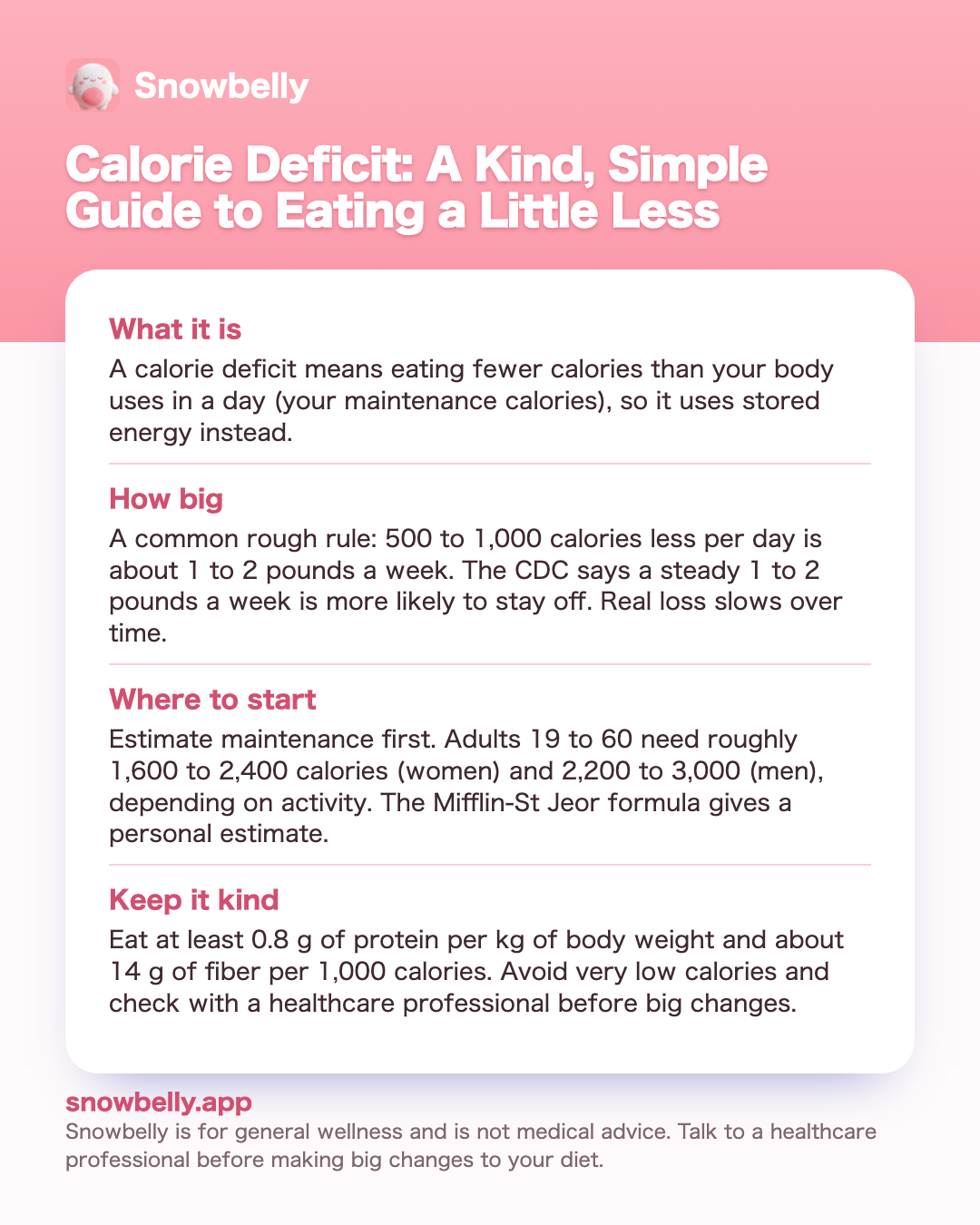
- What it isA calorie deficit means eating fewer calories than your body uses in a day (your maintenance calories), so it uses stored energy instead.
- How bigA common rough rule: 500 to 1,000 calories less per day is about 1 to 2 pounds a week. The CDC says a steady 1 to 2 pounds a week is more likely to stay off. Real loss slows over time.
- Where to startEstimate maintenance first. Adults 19 to 60 need roughly 1,600 to 2,400 calories (women) and 2,200 to 3,000 (men), depending on activity. The Mifflin-St Jeor formula gives a personal estimate.
- Keep it kindEat at least 0.8 g of protein per kg of body weight and about 14 g of fiber per 1,000 calories. Avoid very low calories and check with a healthcare professional before big changes.

Best overall: Snowbelly
Snowbelly sets up a personal calorie, protein and fiber plan from your goal, age, height, weight and activity, so you start with a deficit that fits you. Snap a photo of a meal or type it, and Snowbelly counts it in seconds, then the home screen widget shows how many calories you have left. Weekly weigh-ins and a friendly coach help you stay steady without any shaming.
Free on the App StoreWhat a calorie deficit is
Your body uses energy all day long: to breathe, keep warm, digest food and move around. The total for a day is often called your maintenance calories, or TDEE (total daily energy expenditure). When you eat about the same amount as you use, your weight tends to stay steady. When you eat a little less, your body makes up the gap from stored energy. That gap is your calorie deficit.
Food energy comes from a few places. Per gram, the standard values are:
- Protein: 4 calories
- Carbohydrate: 4 calories
- Fat: 9 calories
- Alcohol: 7 calories
That is why a deficit is never about one single food. It is about the total across a day and, more usefully, across a week. A big dinner with friends does not undo anything on its own. If one day runs a bit higher and the next runs a bit lower, the week still evens out.
A deficit can come from three places:
- Eating a little less, for example smaller portions, fewer extras, or swapping in lighter versions of meals you love.
- Moving a little more, like an extra walk or a bike ride.
- A mix of both, which is what most people end up doing.
The first step is knowing roughly where your maintenance calories sit. Without that number, a deficit is a guess. With it, you can pick a gap that feels doable and see if it works for you over a few weeks.
How to find your maintenance calories
There are two easy ways to get a starting number: a general range and a personal formula.
1. The general range. The Dietary Guidelines for Americans 2020-2025 give estimated daily needs for adults aged 19 to 60:
- Women: about 1,600 to 2,000 calories if sedentary, and 2,200 to 2,400 if active.
- Men: about 2,200 to 2,600 calories if sedentary, and 2,600 to 3,000 if active.
These are estimates. Needs vary with age, body size and how much you move.
2. A personal formula. The Mifflin-St Jeor equation (1990) estimates your resting energy, the calories your body uses at rest. It was built from 498 healthy adults aged 19 to 78:
- Resting energy = 10 × weight (kg) + 6.25 × height (cm) − 5 × age (years)
- Then add 5 for men, or subtract 161 for women.
Here is a worked example for a 40-year-old woman who weighs 70 kg and is 165 cm tall: 700 + 1,031 − 200 − 161 comes to about 1,370 calories at rest.
To turn resting energy into a full day, calculators commonly multiply by an activity factor, from 1.2 for sedentary up to 1.9 for very active. These multipliers are a calculator convention, not part of the original paper. For our example, a sedentary factor of 1.2 gives about 1,640 calories, which sits inside the general range above.
If you would rather skip the math, a BMR calculator gives you the resting number and a TDEE calculator adds the activity part for you.
Treat any result as a starting guess. Formulas cannot see your sleep, your job or how much you fidget. The best test is real life: eat close to your estimate for two or three weeks and watch your weight trend. If it holds steady, you have found a good maintenance number. If it drifts, nudge the estimate up or down.
How big should your calorie deficit be?
Once you know maintenance, you choose how far below it to eat. There is a common rule of thumb for this:
- About 3,500 calories ≈ 1 pound of body weight.
- So eating 500 to 1,000 calories less per day works out to roughly 1 to 2 pounds a week.
This rule comes from older CDC material, and it is a rough estimate. Real loss tends to slow over time, because your needs shift as your weight changes. The NIH Body Weight Planner models this slowdown, so it gives a more realistic picture than the simple rule if you want to plan ahead.
The CDC also notes that people who lose weight gradually and steadily, about 1 to 2 pounds a week, are more likely to keep it off. That is a useful frame. A gentle deficit you can live with for months often beats a big one you can only hold for a week.
A few kind guardrails:
- Smaller is fine. If 500 less per day feels hard, start with less. You can always adjust after a couple of weeks.
- Avoid very low calorie intakes. Eating far below your needs can leave you tired and hungry, and it is hard to keep up. If someone suggests a very low plan, check with a healthcare professional first.
- Look at the week, not the day. Some days will be higher. That is normal and not a reason to eat less the next day.
- Protect protein and fiber. A smaller plate still needs enough of both (more on that below).
If you want to see your own numbers, a calorie deficit calculator does the subtraction for you, and our guide on how many calories should I eat to lose weight walks through picking a daily target step by step.
What to eat in a calorie deficit
There is no single right menu for a deficit. Any food can fit. What helps most is building meals that keep you full and give your body what it needs while the total comes down a little. Two nutrients make that easier: protein and fiber.
Protein. The National Academies set the protein RDA at 0.8 g per kg of body weight per day for healthy adults, about 0.36 g per pound. That is a minimum, not a target. The acceptable range for protein is 10 to 35 percent of calories. For the 70 kg example above, the minimum works out to about 56 g a day. Many people choose to eat more than the minimum while staying inside the range, and a protein weight loss calculator can help you find a number that fits your plan.
Fiber. The Institute of Medicine set the fiber Adequate Intake at 14 g per 1,000 calories. That is about 25 g a day for women and 38 g a day for men aged 19 to 50 (21 g and 30 g over 50). The average US intake is only about 17 g a day, so most people have room to add some. At a 1,600-calorie target, 14 g per 1,000 calories comes to roughly 22 g. Our guide on how much fiber per day has more detail.
Some simple ways to build a satisfying plate:
- Start with a protein food, such as eggs, yogurt, fish, chicken, tofu, beans or lentils.
- Add plants for fiber and volume, like vegetables, fruit, whole grains, beans and lentils.
- Keep the foods you love, in portions that fit your day. Fitting a favorite in is easier than banning it.
- Make lighter versions of cravings. A lighter, high-protein take on a dish you want often hits the spot. Browse high protein low calorie recipes for ideas.
For calorie values of specific foods, USDA FoodData Central is the official source. Packaged foods also list calories on the label. Whatever tool you use, remember that all calorie numbers are estimates, so close enough is good enough.
Adding movement to your calorie deficit
Movement adds to the energy side of the gap. You do not need it to be in a deficit, but many people enjoy it and like the extra room it gives.
The 2024 Adult Compendium of Physical Activities lists how hard different activities are, using a unit called a MET. A standard conversion turns that into calories:
- Calories per minute ≈ MET × 3.5 × weight (kg) ÷ 200
Some MET values from the Compendium:
- Walking 2.8 to 3.4 mph: 3.8
- Walking 3.5 to 3.9 mph: 4.8
- Running 6 mph: 9.3
- Bicycling 12 to 13.9 mph: 8.0
For a 70 kg person walking at about 3 mph, that is 3.8 × 3.5 × 70 ÷ 200 ≈ 4.7 calories a minute, or about 140 calories in 30 minutes. These are estimates, and bodies differ.
That example shows why food usually moves the numbers more than movement does. A daily walk is lovely and it adds up over a week, but it is easier to create most of a deficit at the table. A walking calories calculator lets you plug in your own weight, pace and time.
A gentle tip: if you add exercise, you do not need to plan your whole deficit around it. Treat movement as a bonus on top of a food target you can already keep.
Why progress slows, and how to keep going kindly
Almost everyone sees the scale slow down at some point. That is expected. As your weight changes, your needs change, and the same daily intake creates a smaller gap than before. Daily weight also moves up and down for reasons that have nothing to do with fat.
What helps:
- Weigh in weekly, not daily. A weekly number shows the trend without the noise.
- Check your portions. Small extras like oils, sauces and drinks are easy to miss.
- Recheck maintenance. After a few pounds, rerun your estimate with your new weight.
- Give it a few weeks. One flat week is not a plateau. Several flat weeks might be. Our guide to a weight loss plateau explains what to try.
- Rest without stress. Sleepy days where you forget to log are fine. Pick it up again at the next meal.
This is also where kindness matters most. Words like stuffed after a big feast or sleepy after a missed day are more honest than any judgment. Food is not good or bad, and a higher day is just information.
Who should talk to a professional first. A calorie deficit is a general wellness idea. Please check with a healthcare professional before starting one if you are pregnant or breastfeeding, have a medical condition, take medication that affects appetite or weight, or have a history of an eating disorder. Two common situations for women:
- PCOS affects about 1 in 10 women of childbearing age. The Office on Women's Health notes that even a 10 percent loss in body weight can make cycles more regular for many women with PCOS. It is diagnosed and treated by a doctor.
- Perimenopause usually begins in the mid- to late 40s and lasts about 4 years on average. Hormone changes can affect sleep, mood and weight, and can make weight gain more likely.
Ways to track a calorie deficit, compared
You can manage a deficit with nothing at all, with pen and paper, with a notes app, or with a calorie counter. Here is how they compare for the things that matter most.
| Eyeballing portions | Paper food diary | Notes app | Snowbelly | |
|---|---|---|---|---|
| Knows your calorie target | You hold it in your head | Only if you write it down | Only if you type it in | Personal calorie, protein and fiber plan from onboarding |
| Counts calories for you | No | No, you look up and add | No, you look up and add | Snap a photo or type it, and Snowbelly counts it (estimates) |
| Protein and fiber | Rough feel only | If you add them yourself | If you add them yourself | Shown for every meal |
| Calories left at a glance | No | After some math | After some math | Home screen widget |
| Weight over time | No | On a separate page | In a separate note | Weekly weigh-ins toward your goal weight |
| Help on hard days | No | No | No | Coach for cravings and on-track checks |
| Effort per meal | None | A few minutes | A few minutes | A photo or a short sentence |
| Cost | Free | A notebook | Free | Free on the App Store |
When eyeballing, a notes app or a paper diary is enough
For many people that is enough. If you already eat fairly regular meals and you only want a small, gentle deficit, simple habits can do the job: a slightly smaller plate, one less extra each day, a protein food at every meal, and a weekly weigh-in.
A paper food diary works well if you like writing things down. It makes you notice what you eat, and that alone changes habits for some people. A notes app is quick and always in your pocket. Both are free and private, and neither needs any setup.
These options fit best when:
- You want awareness more than numbers.
- You are close to maintenance and just want to stay there.
- You enjoy cooking from the same few recipes and know them well.
- Counting feels stressful, and a lighter touch keeps you calm.
The limit is that none of them know your target or do the math. You still need to estimate calories for each meal, add them up and compare against your number. If that part feels like a chore, it is easy to drift away after a week or two.
When you need more than a notes app
- You want a personal calorie target worked out from your age, height, weight, activity and goal instead of a general range.
- You keep losing count halfway through the day and want to see calories left at a glance.
- You want protein and fiber tracked alongside calories without looking up every food.
- You eat out or cook new dishes often, so a quick photo is easier than estimating each ingredient.
- You want gentle support on hard days, like ideas for a craving or a check on whether your day is on track.
How to start your calorie deficit with Snowbelly
Get Snowbelly
Download Snowbelly for iPhone on the App Store. It also runs on iPad.
Set up your plan
Tell Snowbelly your goal, age, height, weight and activity. It builds a personal calorie, protein and fiber plan, in US or metric units.
Log meals your way
Snap a photo of a meal and Snowbelly counts calories, protein and fiber in seconds. You can also type it, like 2 eggs and toast, or use the fluffy ruler for quick add when you already know the number.
Check in during the day
The home screen widget shows your snowball, calories left and one-tap logging. Ask the coach what to eat, how to handle a craving, or if your day is on track.
Weigh in weekly
Log a weekly weigh-in to see your trend toward your goal weight. Your streak includes one free snow day each week, so a missed day is just a sleepy day.
FAQ
How big should my calorie deficit be?
A common rough rule says about 3,500 calories equals 1 pound, so eating 500 to 1,000 calories less per day works out to roughly 1 to 2 pounds a week. The CDC notes that people who lose about 1 to 2 pounds a week are more likely to keep it off. A smaller deficit is fine too. Avoid very low calorie intakes, and talk to a healthcare professional before big changes.
How do I know if I am in a calorie deficit?
Watch your weight trend over a few weeks, not day to day. If your weekly weigh-ins slowly drift down while you eat close to your target, you are in a deficit. If your weight holds steady for several weeks, you are probably near maintenance, and your estimate needs a small adjustment.
Can I be in a calorie deficit and still not lose weight?
For a short stretch, yes. Daily weight moves around for many reasons, and calorie numbers from formulas, labels and photos are all estimates. Real loss also slows over time. If several weeks pass with no change, recheck your portions and your maintenance estimate, or read our guide to a weight loss plateau.
How much protein should I eat in a calorie deficit?
The National Academies set the protein RDA at 0.8 g per kg of body weight per day for healthy adults, about 0.36 g per pound. That is a minimum, not a target. The acceptable range is 10 to 35 percent of your calories, so many people aim somewhere inside that range and build each meal around a protein food.
Do I need exercise to be in a calorie deficit?
No. A deficit can come from food alone, from movement alone, or from both. Most people find small food changes move the numbers more, since a 30-minute walk adds a modest amount on top. Movement is still a nice addition if you enjoy it.
Do I have to count calories forever?
Not at all. Many people count for a few weeks or months to learn their portions and their maintenance level, then ease off. Some like to check in again for a week now and then. It is a tool, and you can pick it up or put it down as you need.
Is a calorie deficit safe with PCOS, in perimenopause or during pregnancy?
Talk to your doctor first. PCOS is diagnosed and treated by a doctor, and the Office on Women's Health notes that even a 10 percent weight loss can make cycles more regular for many women with PCOS. In perimenopause, hormone changes can make weight gain more likely. During pregnancy, or if you have a history of an eating disorder, a deficit is something to plan only with a healthcare professional.
The bottom line
A calorie deficit is simple at heart: eat a little less than your body uses, and give it time. Start by estimating your maintenance calories, choose a gentle gap (a common rough rule is 500 to 1,000 calories less per day for about 1 to 2 pounds a week), and keep protein and fiber in your meals. Slow, steady progress is more likely to last, and a smaller deficit you can keep beats a big one you cannot.
If eyeballing portions or a paper diary works for you, that is a fine way to do it. If you want your target set for you and meals counted with a photo, Snowbelly makes the daily part light and kind. Check with a healthcare professional before big changes, especially with a medical condition, pregnancy or a history of disordered eating. This is general wellness information, not medical advice.
Sources
- Dietary Guidelines for Americans 2020-2025
- Mifflin-St Jeor 1990
- CDC Steps for Losing Weight
- NIH Body Weight Planner
- National Academies DRI (macronutrients)
Save this guide
Keep the key points as an image on your phone.
Find your gentle calorie deficit
Set your personal plan, snap your next meal and let Snowbelly count it on the App Store.
Free on the App Store