Snowbelly

Quick answer
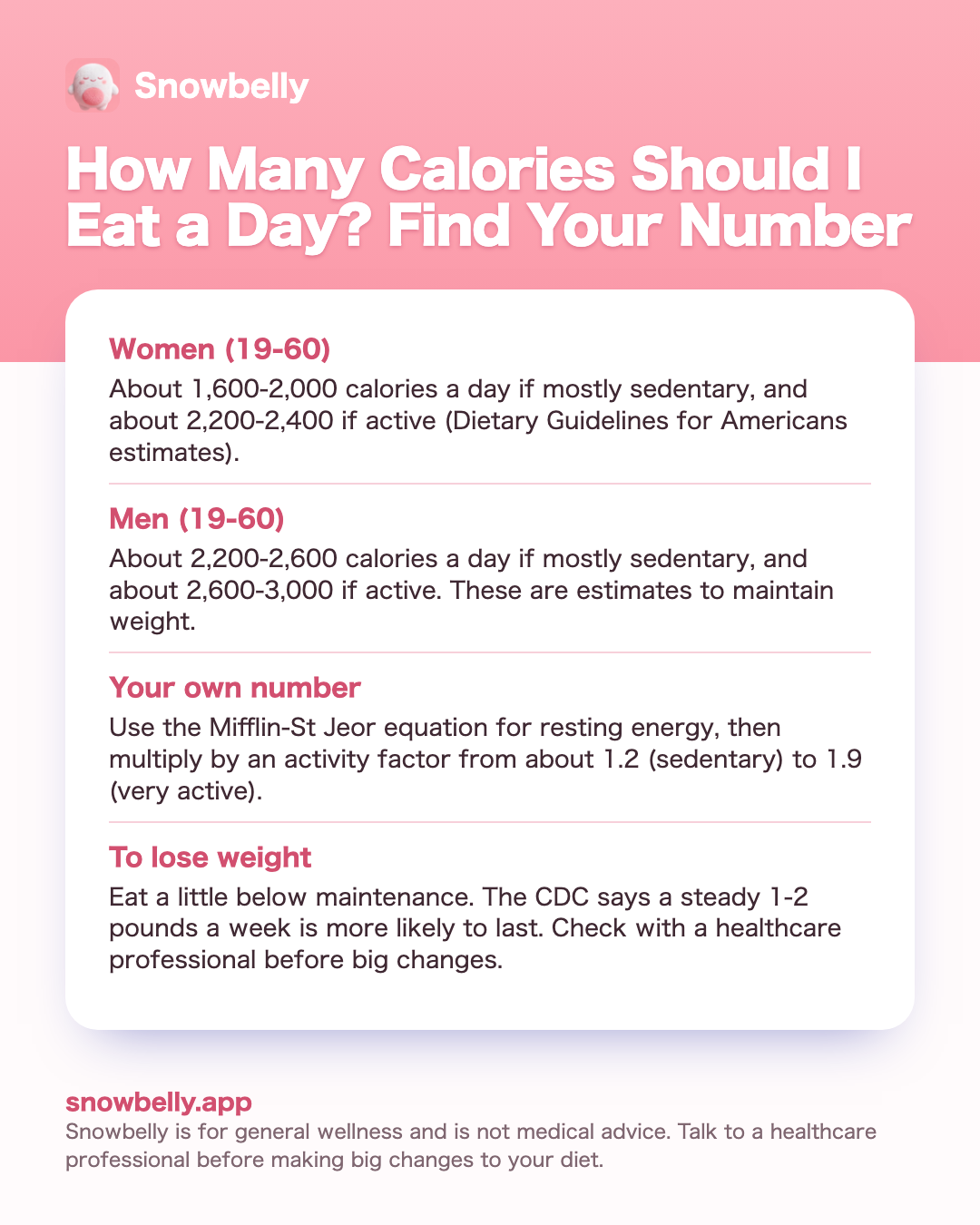
- Women (19-60)About 1,600-2,000 calories a day if mostly sedentary, and about 2,200-2,400 if active (Dietary Guidelines for Americans estimates).
- Men (19-60)About 2,200-2,600 calories a day if mostly sedentary, and about 2,600-3,000 if active. These are estimates to maintain weight.
- Your own numberUse the Mifflin-St Jeor equation for resting energy, then multiply by an activity factor from about 1.2 (sedentary) to 1.9 (very active).
- To lose weightEat a little below maintenance. The CDC says a steady 1-2 pounds a week is more likely to last. Check with a healthcare professional before big changes.

Best overall: Snowbelly
Snowbelly turns this question into a personal answer: during setup you enter your goal, age, height, weight and activity, and it builds your own calorie, protein and fiber plan. Then you snap a photo of a meal and Snowbelly counts it, so you can see calories left for the day right on your home screen widget. It keeps the number in view without turning food into homework.
Free on the App StoreDaily calorie needs for adults at a glance
The Dietary Guidelines for Americans give estimated daily calorie needs for adults aged 19 to 60. They are ranges, not rules, and they shift with body size and activity.
- Women, sedentary: about 1,600 to 2,000 calories a day
- Women, active: about 2,200 to 2,400 calories a day
- Men, sedentary: about 2,200 to 2,600 calories a day
- Men, active: about 2,600 to 3,000 calories a day
Why are the ranges so wide? Two people of the same sex can differ a lot in height, weight and how much they move. A tall person who walks all day uses more energy than a shorter person who sits at a desk. Both are normal. They just have different numbers.
These figures describe what it takes to maintain your weight. That steady point, where you neither gain nor lose, is often called your maintenance calories. If you want to stay where you are, aim near it. If you want to lose or gain, you adjust from there in small steps.
Treat the ranges as a starting point. For many people that is enough to get a feel for the right ballpark and to notice if a typical day is far above or below it. If you want a number that fits your own body more closely, a simple formula can help.
How to work out your own number with Mifflin-St Jeor
Most online calculators use the Mifflin-St Jeor equation, published in 1990. Researchers built it from measurements of 498 healthy adults aged 19 to 78. It estimates your resting energy, the calories your body uses before you add any movement.
The formula:
- Resting energy = 10 × weight (kg) + 6.25 × height (cm) − 5 × age (years)
- Then add 5 for men, or subtract 161 for women
That result is your basal metabolic rate, or BMR. A BMR calculator does this math for you, including the switch from pounds and inches.
Then add activity. Calculators multiply BMR by an activity factor, from about 1.2 for sedentary up to 1.9 for very active. These multipliers are a common calculator convention, not part of the original paper, so think of them as helpful guesses. The result is your total daily energy expenditure, which a TDEE calculator gives you in one step.
A worked example. Take a 35-year-old woman who is 165 cm tall and weighs 65 kg:
- 10 × 65 = 650
- 6.25 × 165 = 1,031
- 5 × 35 = 175
- 650 + 1,031 − 175 − 161 = about 1,345 calories at rest
If she is mostly sedentary, 1,345 × 1.2 is about 1,614 calories a day. If she is very active, 1,345 × 1.9 is about 2,556. Notice how both land close to the Dietary Guidelines ranges above. The formula and the table tell a similar story, the formula just makes it personal.
Every result here is an estimate. Your real needs can sit a bit above or below. The best check is to eat near your estimate for a few weeks and see what your weight does.
What moves your number up or down
Looking at the formula closely shows exactly what nudges your daily calories:
- Weight: each extra kilogram adds about 10 calories at rest.
- Height: each extra centimeter adds about 6.25 calories at rest.
- Age: each extra year lowers the estimate by 5 calories at rest.
- Sex: at the same size and age, the male estimate is 166 calories higher at rest (plus 5 versus minus 161).
- Activity: this is the biggest lever. Going from a 1.2 to a 1.9 multiplier means close to 60 percent more calories in a day.
A few practical takeaways follow from this.
Your number changes as you change. If you lose weight, your resting estimate drops a little too, because there is less of you to fuel. That is one reason progress often slows after the first few months, and why a weight loss plateau is so common and so normal. Recalculating every so often keeps your target honest.
Movement counts more than you might think. Daily steps, chores, standing at work and playing with kids all add up. Two people with the same BMR can need very different amounts of food simply because one moves more through the day.
Birthdays matter only a little. Five calories a year is small. Over a decade it is about 50 calories a day at rest, which is noticeable but gentle. Changes in activity with age usually make a bigger difference than age itself.
How many calories should I eat to lose weight?
If your goal is weight loss, the idea is simple: eat a little less than your maintenance number, so your body makes up the gap from stored energy. Our guide on how many calories should I eat to lose weight goes deeper, but here are the basics.
Aim for a gentle pace. The CDC notes that people who lose weight gradually and steadily, about 1 to 2 pounds a week, are more likely to keep it off. Slow is not a failure. Slow is the plan.
Know the rough rule, and its limits. A common estimate says about 3,500 calories equals 1 pound, so eating 500 to 1,000 fewer calories a day would mean roughly 1 to 2 pounds a week. This rule comes from older CDC material and is only a rough guide. Real loss slows over time as your needs drop. The NIH Body Weight Planner models that slowdown if you want a more realistic forecast.
Check the gap against your total. Subtracting 1,000 calories works very differently for someone who needs 3,000 than for someone who needs 1,600. In the worked example above, a sedentary woman with a maintenance of about 1,614 would be left with very little after a 1,000-calorie cut. That is well below any adult range and not something to try on your own. A smaller gap, a bit more movement, or both, makes more sense. A calorie deficit calculator helps you pick a gap that fits your number.
Get support when it matters. If you have a medical condition, are pregnant or breastfeeding, have a history of disordered eating, or are planning a big change, talk with a doctor or registered dietitian first. They can tailor a target to you.
Protein and fiber: what to eat inside your calories
Calories tell you how much. Protein and fiber help with what. Both can make a calorie target feel more comfortable to live with.
Protein. The National Academies set the protein RDA at 0.8 g per kg of body weight per day for healthy adults, which is about 0.36 g per pound. That is a minimum, not a target. The acceptable range for protein is 10 to 35 percent of your calories. For the 65 kg woman in our example, the minimum works out to about 52 g a day. Read more in how much protein should I eat a day.
Fiber. The Institute of Medicine guidance is 14 g of fiber per 1,000 calories. That comes to about:
- 25 g a day for women aged 19 to 50, and 21 g over 50
- 38 g a day for men aged 19 to 50, and 30 g over 50
The average US intake is about 17 g a day, so many people have room to grow here. If you eat about 2,000 calories, the 14 g rule points to about 28 g of fiber. Our page on how much fiber per day has easy ways to get there.
Where calories come from. Each gram of protein and carbohydrate provides about 4 calories, fat about 9, and alcohol about 7. That is why a small drizzle of oil or a drink can shift a day more than you might expect, and why lean protein and high-fiber foods tend to fill you up for fewer calories. For calorie values of specific foods, USDA FoodData Central is the trusted public source.
Turning your number into an everyday habit
Knowing your number is the first half. The second half is seeing roughly where you are during a normal day, without making food stressful.
Estimates are fine. Whether you guess portions, read labels or log a photo, the calorie counts you see are estimates. That is okay. Consistency matters more than perfection. If you log the same way each day, your trend will be clear even if any single meal is a little off.
Look at the week, not one meal. A big dinner with friends does not undo anything. Some days you will be stuffed, some days lighter. The weekly picture is what shapes progress.
Make it easy to log. The easier logging feels, the more likely you are to keep going. That is where a picture calorie counter helps: you snap a photo and get calories, protein and fiber in seconds. With Snowbelly you can also type a meal like '2 eggs and toast', or use quick add with a fluffy ruler when you already know the number.
Keep it kind. In Snowbelly, a snowball mascot reacts to your day. It looks happy when you eat well, stuffed after a big feast, and sleepy if you forget to log. There is a streak with one free snow day each week, so a missed day is just a rest. A friendly Coach can tell you if your day is on track, suggest what to eat, or help you beat a craving, and it knows your numbers.
If you want to compare options, our guide to choosing a calorie tracker walks through what to look for.
Daily targets for adults at a glance
Here are the main daily numbers from official sources in one place. Calorie figures are estimates to maintain weight for adults aged 19 to 60. Your own needs may differ.
| Daily number | Women | Men | Source |
|---|---|---|---|
| Calories, sedentary | 1,600-2,000 | 2,200-2,600 | Dietary Guidelines for Americans |
| Calories, active | 2,200-2,400 | 2,600-3,000 | Dietary Guidelines for Americans |
| Protein, minimum (RDA) | 0.8 g per kg body weight | 0.8 g per kg body weight | National Academies DRI |
| Protein, share of calories | 10-35% | 10-35% | National Academies DRI |
| Fiber, ages 19-50 | about 25 g | about 38 g | Institute of Medicine |
| Fiber, over 50 | about 21 g | about 30 g | Institute of Medicine |
When eyeballing or a paper diary is enough
You do not need an app to answer this question. For many people, a free and simple approach is enough.
Eyeballing portions works well if your meals are fairly regular, your weight is stable, and you mainly want a sense of whether you are in the right range. Knowing that a sedentary adult woman needs roughly 1,600 to 2,000 calories, for example, can be enough to notice when a typical day runs much higher or lower.
A notes app or paper food diary is a great next step. Writing down what you eat for a week or two builds awareness quickly. You start to see patterns, like when hunger hits or which meals keep you full. You can add up rough calories from food labels and USDA FoodData Central.
A one-time calculation may be all you need. Run the Mifflin-St Jeor formula once, pick an activity level, and use the result as a guide. If your weight stays steady over a few weeks, your estimate is close enough.
These options cost nothing and keep things light. If they feel easy and you are happy with your progress, there is no need to change.
When you might want more than a notebook
- You want to lose weight at a steady pace and need to see calories left each day, not just a total at night.
- Adding up calories by hand feels like a chore, so you keep stopping after a few days.
- You also want to keep an eye on protein and fiber, not just calories.
- You like gentle nudges, such as reminders, a streak or a quick check-in with a coach about whether your day is on track.
- You want weekly weigh-ins and your progress toward a goal weight in the same place as your meals.
How to start counting with Snowbelly
Get the app
Download Snowbelly for iPhone. It is free on the App Store, and it also works on iPad.
Set up your plan
Enter your goal, age, height, weight and activity level. Snowbelly builds your personal calorie, protein and fiber plan, in US or metric units.
Log your first meal
Snap a photo and Snowbelly counts it, type it in plain words, or use quick add with the fluffy ruler if you already know the number.
Check in during the day
Add the home screen widget to see your snowball and calories left, with one-tap logging. Ask the Coach if your day is on track or what to eat next.
Weigh in once a week
Log a weekly weigh-in to see your progress toward your goal weight. Your streak includes one free snow day each week, so a quiet day is no problem.
FAQ
Is 1,200 calories a day enough?
For most adults, 1,200 calories is below the estimated ranges in the Dietary Guidelines for Americans, which start at about 1,600 calories a day for sedentary women and 2,200 for sedentary men. Eating far below your needs is hard to keep up and not something to try on your own. If you are thinking about a very low intake, talk with a doctor or registered dietitian first.
How many calories should I eat a day to lose weight?
Start from your maintenance number and eat a little less. The CDC notes that people who lose about 1 to 2 pounds a week, gradually and steadily, are more likely to keep it off. A common rough rule says 500 to 1,000 fewer calories a day leads to about 1 to 2 pounds a week, but real loss slows over time. If that gap would push you far below the adult ranges, choose a smaller one.
Do I need to eat more on days I exercise?
Activity raises your needs. In the Dietary Guidelines ranges, active women need about 2,200 to 2,400 calories a day versus 1,600 to 2,000 when sedentary. Calculators use activity multipliers from about 1.2 for sedentary to 1.9 for very active. If your routine changes a lot, update your activity level so your estimate keeps up.
What is the difference between BMR and TDEE?
BMR, or basal metabolic rate, is the energy your body uses at rest. The Mifflin-St Jeor equation estimates it from weight, height, age and sex. TDEE, or total daily energy expenditure, adds your activity on top, usually by multiplying BMR by an activity factor. TDEE is the number closest to how many calories you eat a day to maintain your weight.
Do calorie needs change as I get older?
Yes, a little. In the Mifflin-St Jeor equation, each extra year of age lowers the resting estimate by 5 calories. Over ten years that is about 50 calories a day at rest, before activity. Fiber guidance also shifts after 50, from about 25 g to 21 g for women and from 38 g to 30 g for men.
Is the 3,500-calorie rule accurate?
It is a rough estimate. The idea that 3,500 calories equals about 1 pound comes from older CDC material, and it works best as a quick starting guess. As you lose weight, your body needs fewer calories, so progress slows. The NIH Body Weight Planner models this change over time and gives a more realistic picture.
Are photo calorie counts exact?
No. Any calorie count from a photo or a typed description is an estimate, and so are most portion guesses on paper. That is fine for daily tracking. What helps most is logging in a steady way, so your totals are consistent from day to day and you can see the trend.
The bottom line
How many calories should you eat a day? For most adults aged 19 to 60, the Dietary Guidelines estimate about 1,600 to 2,400 for women and 2,200 to 3,000 for men, depending on activity. To get closer to your own number, use the Mifflin-St Jeor equation and an activity multiplier, then watch how your weight responds over a few weeks. If you want to lose weight, a small gap below maintenance and a pace of about 1 to 2 pounds a week is a kind, lasting place to start.
A notebook or a quick calculation is enough for many people. If you want your personal number, protein and fiber in view all day with simple photo logging, Snowbelly is a friendly way to do it. This is general wellness information, not medical advice. If you have a health condition, are pregnant, or are planning a big change, check in with a healthcare professional first.
Sources
- Dietary Guidelines for Americans 2020-2025
- MSD Manual: Estimated number of calories needed based on age, sex and activity level
- Mifflin-St Jeor 1990: A new predictive equation for resting energy expenditure
- CDC: Steps for Losing Weight
- National Academies: Dietary Reference Intakes for Macronutrients
Save this guide
Keep the key points as an image on your phone.
Find your daily number with Snowbelly
Get started, let Snowbelly set your personal calorie plan, and snap your next meal to see where your day stands.
Free on the App Store