Snowbelly

Quick answer
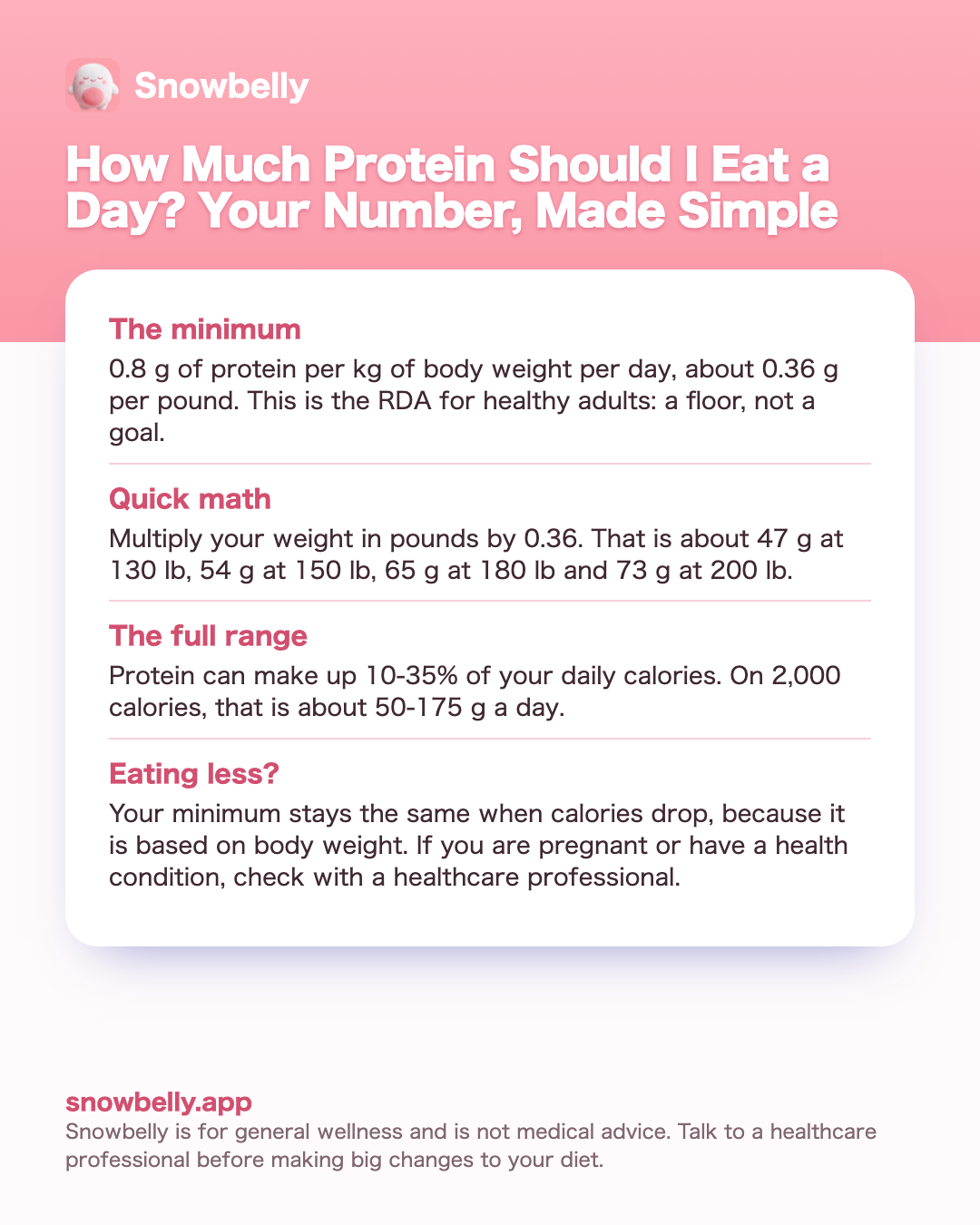
- The minimum0.8 g of protein per kg of body weight per day, about 0.36 g per pound. This is the RDA for healthy adults: a floor, not a goal.
- Quick mathMultiply your weight in pounds by 0.36. That is about 47 g at 130 lb, 54 g at 150 lb, 65 g at 180 lb and 73 g at 200 lb.
- The full rangeProtein can make up 10-35% of your daily calories. On 2,000 calories, that is about 50-175 g a day.
- Eating less?Your minimum stays the same when calories drop, because it is based on body weight. If you are pregnant or have a health condition, check with a healthcare professional.

Best overall: Snowbelly
Knowing your protein number is step one. Reaching it on a busy day is step two. Snowbelly sets up a personal calorie, protein and fiber plan from your goal, age, height, weight and activity, then you snap a photo of a meal and Snowbelly counts the protein in seconds, and the Coach can suggest a protein-friendly idea when you are running low, without any shaming.
Free on the App StoreThe protein RDA: 0.8 grams per kilogram of body weight
The most widely used protein number in the US comes from the National Academies, the group behind the Dietary Reference Intakes. Their Recommended Dietary Allowance (RDA) for protein is 0.8 grams per kilogram of body weight per day for healthy adults. In pounds, that is about 0.36 grams per pound.
Two things make this number easy to misread:
- It is a minimum, not a target. The RDA is set to cover the needs of nearly all healthy adults. Think of it as the floor you want to stay above, not a ceiling and not a goal you have to hit to the gram.
- It scales with your body, not your calories. Your protein RDA is based on your weight. A 150-pound person has the same minimum whether they eat 1,800 or 2,400 calories that day.
So for a 150-pound adult, the minimum is about 54 grams a day. For a 200-pound adult, it is about 73 grams. Same rule, different bodies, different totals.
The RDA is written for healthy adults. Children, teens, people who are pregnant or breastfeeding, and anyone with a medical condition can have different needs, so those situations are worth talking through with a healthcare professional.
How to work out your protein per day in three steps
You do not need a spreadsheet for the basic number. The calculator on your phone is plenty.
- Find your weight in kilograms. If you know your weight in pounds, divide by 2.2. For example, 150 pounds ÷ 2.2 ≈ 68 kg.
- Multiply by 0.8. 68 × 0.8 ≈ 54 grams of protein a day.
- Or skip the conversion. Multiply your weight in pounds by 0.36. 150 × 0.36 = 54 grams.
That result is your daily minimum. To see how many calories it adds up to, multiply the grams by 4, since protein has 4 calories per gram. In our 150-pound example, 54 g × 4 = 216 calories from protein.
For comparison, carbohydrate also has 4 calories per gram, fat has 9 and alcohol has 7. That is why a gram of protein and a gram of carbs count the same toward your calories, while fat adds up faster.
If you like seeing all your numbers together, a macro calculator shows protein next to carbs and fat, and a calorie calculator gives you the daily calorie estimate that the percentages in the next section are built on.
The 10-35% range: how high can protein go?
The RDA tells you the minimum. The National Academies also set an Acceptable Macronutrient Distribution Range (AMDR) for protein: 10-35% of your daily calories. That range leaves a lot of room above the minimum.
To turn it into grams, multiply your calories by the percentage, then divide by 4. Here is how it looks at common calorie levels:
- 1,600 calories: about 40-140 g of protein
- 2,000 calories: about 50-175 g
- 2,200 calories: about 55-193 g
- 2,400 calories: about 60-210 g
- 2,600 calories: about 65-228 g
- 3,000 calories: about 75-263 g
Those calorie levels cover the estimated needs of most adults aged 19-60, according to the Dietary Guidelines for Americans: about 1,600-2,000 calories for sedentary women and 2,200-2,400 for active women, and about 2,200-2,600 for sedentary men and 2,600-3,000 for active men. These are estimates. Your own needs depend on your age, size and activity, so if you are not sure where you land, start with how many calories should I eat a day.
Most people do not need to live at either edge of the range. A comfortable approach is to meet your RDA first, then let protein land wherever it fits within 10-35% with the foods you enjoy.
How much protein to eat a day when losing weight
When you eat fewer calories to lose weight, your protein minimum does not shrink with your plate. It is still based on your body weight. That means protein naturally takes up a bigger share of a smaller day.
Here is the math for a 150-pound person eating 1,600 calories: 54 g × 4 = 216 calories, or about 14% of the day. That is still well inside the 10-35% range, with room to go higher if it suits your meals.
A few kind guardrails while you are in a calorie deficit:
- Go gently. The CDC notes that people who lose weight gradually and steadily, about 1 to 2 pounds a week, are more likely to keep it off. Very low calorie days leave little room for protein, fiber and the foods you like.
- Spread protein across meals. It is easier to reach a daily number in three or four smaller pieces than in one big dinner.
- Pair it with fiber. The fiber Adequate Intake is about 25 g a day for women and 38 g for men aged 19-50, while the average US intake is about 17 g. Beans and lentils bring both protein and fiber. See how much fiber per day for the full picture.
- Expect the scale to wiggle. Real weight loss tends to slow over time, even when you are doing everything right.
If you want a number shaped around a weight loss goal, the protein weight loss calculator walks you through it step by step.
Who should check their protein number with a professional
The 0.8 g per kg rule is a good starting place for healthy adults. Some people are better served by a personal conversation with a doctor or registered dietitian before changing how much protein they eat:
- People who are pregnant or breastfeeding
- Anyone with a kidney or liver condition, diabetes or another ongoing health condition
- Older adults, especially if appetite or weight has changed recently
- People training hard for a sport
- Anyone with a history of an eating disorder, or who finds tracking food stressful
- People managing PCOS or going through perimenopause, where hormones and weight can interact
There is no shame in asking. A professional can look at your whole picture, including medications and lab results, and help you choose a number that fits your body and your life.
Simple ways to get enough protein through the day
Once you know your number, the easy part is food you already like. Protein shows up in plenty of everyday choices:
- Animal foods: eggs, yogurt, milk, cheese, fish, chicken, turkey and lean meats
- Plant foods: beans, lentils, tofu, tempeh, edamame, nuts and seeds
- Easy add-ons: yogurt with your oats, beans in a soup, an egg on toast
We do not list grams per food here, because amounts change with brand, portion and cooking. For values on specific foods, USDA FoodData Central is the official US source.
A few ideas to make it easier:
- Start with breakfast. A high protein low calorie breakfast gives you a head start on the day.
- Plan one snack. Keep a couple of high protein low cal snacks around for the afternoon.
- Build a short list. Browse foods high in protein low in calories when you want more filling options for fewer calories.
No food is off limits. Protein is one piece of a balanced day, alongside fiber, fruits, vegetables and the meals that make you happy.
Minimum protein per day by body weight
Based on the RDA of 0.8 g of protein per kg of body weight for healthy adults, rounded. This is the daily minimum. Anything up to 35% of your calories falls within the AMDR.
| Body weight (lb) | Body weight (kg) | Minimum protein per day | Calories from that protein |
|---|---|---|---|
| 120 lb | about 54 kg | about 44 g | about 176 |
| 140 lb | about 64 kg | about 51 g | about 204 |
| 160 lb | about 73 kg | about 58 g | about 232 |
| 180 lb | about 82 kg | about 65 g | about 260 |
| 200 lb | about 91 kg | about 73 g | about 292 |
| 220 lb | about 100 kg | about 80 g | about 320 |
| 250 lb | about 113 kg | about 91 g | about 364 |
When eyeballing or a notes app is enough
For many people that is enough. If you eat a fairly steady routine, know which foods bring protein to your plate and feel well, you may not need to track at all. A simple habit, like including a protein food at each meal, can carry a lot of people past their RDA without a single number.
A notes app or a paper food diary works well too. Write down what you eat for three or four ordinary days, add up rough protein, and compare it with your minimum from the table above. If you are comfortably above it, you have your answer, and you can check in again every few months.
The limits show up when you want more than a rough sense. Adding up protein by hand is slow, and it is easy to forget the snack or the milk in your coffee. Your totals also will not adjust to a new goal or a new weight unless you redo the math yourself.
When you might want more help
- You are eating fewer calories to lose weight and want to be sure protein keeps up.
- Your weight is changing, so your minimum is changing too, and you would rather not redo the math every week.
- You want protein and fiber side by side without adding up every meal by hand.
- You often notice you are low on protein by dinner and want ideas in the moment.
- You tried a protein tracker app before and found logging too slow or too stressful.
How to start tracking protein with Snowbelly
Get Snowbelly
Snowbelly is on the App Store for iPhone, and iPad is supported. Download it and meet your fluffy snowball.
Set up your plan
Enter your goal, age, height, weight and activity. Snowbelly builds a personal calorie, protein and fiber plan from your answers, and you can choose US or metric units.
Log meals the easy way
Snap a photo of your meal and Snowbelly counts calories, protein and fiber in seconds. Or type it, like "2 eggs and toast". Already know the number? Use quick add with the fluffy ruler.
Check in during the day
The home screen widget shows your snowball, calories left and one-tap logging. Ask the Coach what to eat or whether your day is on track. It knows your numbers and never shames.
Weigh in weekly
Weekly weigh-ins keep your progress toward your goal weight in view. Missed a day? Your streak comes with one free snow day each week, and reminders help you pick back up.
FAQ
How much protein should I eat a day to lose weight?
Start with the same minimum: 0.8 g per kg of body weight, about 0.36 g per pound. That number is based on your weight, not your calories, so it stays the same when you eat less. Protein simply becomes a bigger share of a smaller day. Many people then choose an amount somewhere higher within the 10-35% of calories range. For a personal number, a registered dietitian can help.
Is 100 grams of protein a day too much?
100 g of protein is 400 calories. On a 2,000-calorie day that is 20% of your calories, inside the 10-35% range. On 1,600 calories it is 25%, also inside. Whether it is right for you depends on your body and your health. If you have kidney disease or another ongoing condition, ask your doctor before raising your protein.
How many grams of protein per pound should I eat?
The RDA works out to about 0.36 g of protein per pound of body weight per day. Multiply your weight in pounds by 0.36: 130 pounds is about 47 g, and 180 pounds is about 65 g. Keep in mind this is a minimum for healthy adults, not a target you must hit exactly.
Do women need less protein than men?
The RDA is the same per kilogram for healthy adult women and men: 0.8 g per kg. Daily totals differ because bodies differ in size, so a lighter person has a lower total. Pregnancy and breastfeeding can change needs, so that is a good time to talk with a healthcare professional.
Can you eat too much protein?
The AMDR tops out at 35% of calories, which is a useful upper guide for healthy adults. Going very high also leaves less room in your day for carbs, fat and fiber-rich foods. If you have a health condition, check with your doctor about the amount that is right for you.
Do I need protein shakes to reach my protein goal?
No rule says you do. Everyday foods like eggs, yogurt, beans, lentils, fish, tofu and chicken all bring protein. Shakes are one option if they are convenient for you. If you want lighter meal ideas, Snowbelly's recipes turn what you are craving into a lighter, high-protein version with big easy steps.
How does Snowbelly track protein?
Snowbelly builds a personal calorie, protein and fiber plan from your goal, age, height, weight and activity. Snap a photo of a meal or type it, and Snowbelly counts calories, protein and fiber in seconds. Results are estimates, so treat them as a friendly guide rather than an exact number.
The bottom line
For most healthy adults, the answer starts at 0.8 grams of protein per kilogram of body weight, about 0.36 grams per pound. That is a minimum, not a goal. Anywhere from 10-35% of your calories is within the accepted range, so there is plenty of room to eat in a way you enjoy.
If you eat steadily and feel good, a quick check with a notes app may be all you need. If you want protein, fiber and calories kept together while you work toward a goal, Snowbelly keeps it light: snap a photo, and your snowball keeps you company. If you have a medical condition, are pregnant or plan a big change, talk with a healthcare professional first. This is general wellness information, not medical advice.
Sources
- National Academies DRI (macronutrients)
- Dietary Guidelines for Americans 2020-2025
- MSD Manual calorie table
- CDC Steps for Losing Weight
- Academy of Nutrition and Dietetics fiber position
Save this guide
Keep the key points as an image on your phone.
Find your protein number with Snowbelly
Set up your personal calorie, protein and fiber plan in a few taps on the App Store.
Free on the App Store