Snowbelly

Quick answer
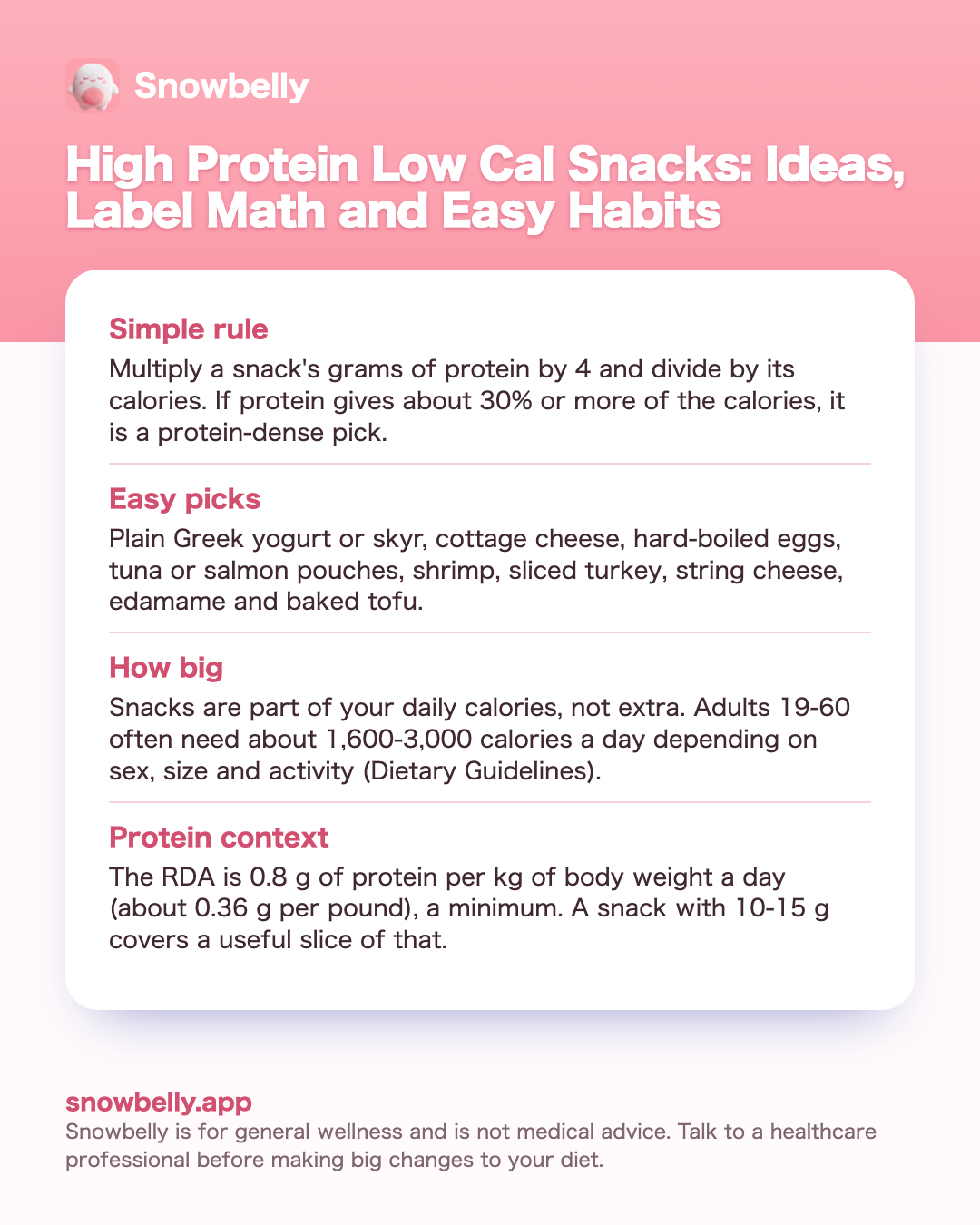
- Simple ruleMultiply a snack's grams of protein by 4 and divide by its calories. If protein gives about 30% or more of the calories, it is a protein-dense pick.
- Easy picksPlain Greek yogurt or skyr, cottage cheese, hard-boiled eggs, tuna or salmon pouches, shrimp, sliced turkey, string cheese, edamame and baked tofu.
- How bigSnacks are part of your daily calories, not extra. Adults 19-60 often need about 1,600-3,000 calories a day depending on sex, size and activity (Dietary Guidelines).
- Protein contextThe RDA is 0.8 g of protein per kg of body weight a day (about 0.36 g per pound), a minimum. A snack with 10-15 g covers a useful slice of that.

Best overall: Snowbelly
Snowbelly makes snack math disappear: snap a photo of your yogurt bowl or egg plate and Snowbelly counts calories, protein and fiber in seconds, right next to your personal plan. If you are stuck for ideas, ask the Coach what to eat or how to beat a craving, or tell Recipes what you are in the mood for and get a lighter, high-protein version.
Free on the App StoreWhat makes a snack high protein and low calorie
There is no official definition of a high protein, low calorie snack, so a simple yardstick helps. Protein has 4 calories per gram, carbohydrate also has 4, and fat has 9. With those numbers you can see how much of any snack's energy comes from protein in one line of math:
Protein share = (grams of protein × 4) ÷ total calories
Say a label shows 15 g of protein and 150 calories. That is 15 × 4 = 60 calories from protein, and 60 ÷ 150 = 40%. For context, the National Academies set an acceptable range of 10-35% of daily calories from protein. A snack at or above the top of that range is doing a lot of protein work for its size.
A handy rule of thumb:
- 30% or more: protein-dense, a strong high protein, low calorie pick
- 20-30%: a fair source of protein, great as part of a mix
- Under 20%: can be tasty and useful, but protein is not its main job
"Low calorie" depends on you. A snack that is light for a tall, active person may be a bigger share of the day for someone shorter or less active. The goal is not the smallest possible number. It is a snack that fits your day and leaves you comfortable until your next meal.
Fiber is the quiet partner here. The Institute of Medicine set an Adequate Intake of 14 g of fiber per 1,000 calories, and the average US intake is only about 17 g a day. Pairing a protein food with fruit, vegetables or beans helps you nudge both numbers in the right direction.
For a longer list of whole foods to build snacks from, see foods high in protein low in calories. To see where protein fits across your whole day, try the macro calculator.
High protein low cal snack ideas you can grab today
These ideas lean on foods that tend to be rich in protein for their calories. Exact values change with brand, recipe and portion, so check the label or look the food up in USDA FoodData Central before you rely on a number.
Dairy and dairy-style
- Plain Greek yogurt or skyr with berries and a pinch of cinnamon
- Cottage cheese with cucumber, cherry tomatoes and black pepper
- Cottage cheese with pineapple or peach slices for a sweet version
- A string cheese with an apple or a handful of grapes
- A glass of milk or soy milk next to a piece of fruit
Eggs
- Hard-boiled eggs with salt and a shake of seasoning
- A quick microwave egg mug with spinach and salsa
- Egg white bites from the fridge section (check the label, recipes vary)
Seafood and meat
- A tuna or salmon pouch on cucumber rounds
- Shrimp with cocktail sauce
- Sliced turkey or chicken breast rolled around pickles or bell pepper strips
- Jerky, choosing one with a short ingredient list (labels vary a lot)
Plant-based
- Steamed edamame with sea salt
- Baked or air-fried tofu cubes with soy sauce
- Roasted chickpeas (more carbohydrate, so the protein share is lower)
- Hummus with crunchy vegetables (a modest protein share, but a lovely dip)
Sweet tooth friendly
- Greek yogurt stirred with cocoa powder and a few raspberries
- Cottage cheese blended until smooth with vanilla and cinnamon
- A protein shake blended with ice and frozen berries
- Skyr layered with sliced banana
No food on this list is required, and nothing is off-limits. If a snack you love has a low protein share, pair it with something protein-rich instead of dropping it. Want something you can cook ahead? Our high protein low calorie recipes page has bigger ideas, and the high protein low calorie breakfast guide covers mornings.
In Snowbelly, tell Recipes what you are craving, like a chocolate snack or something salty and crunchy, and it suggests a lighter, high-protein version with big, easy steps. Every recipe is saved and searchable, so your favorites are easy to find again.
How many calories and how much protein a snack should have
Snacks are a slice of your daily total, not a separate budget. So the first step is knowing roughly how many calories your day needs.
The Dietary Guidelines for Americans estimate these daily needs for adults aged 19-60:
- Women: about 1,600-2,000 calories if sedentary, 2,200-2,400 if active
- Men: about 2,200-2,600 calories if sedentary, 2,600-3,000 if active
These are estimates. Your needs shift with age, body size and how much you move. If you want a number tailored to you, start with how many calories should I eat a day.
Some people eat no snacks at all, and others like two or three small ones. Both can work. A practical way to decide is to plan your meals first, then see what room is left. If your meals already cover most of your day, one modest snack may be plenty. If you have long gaps between meals, two smaller snacks might feel better.
Protein. The RDA for healthy adults is 0.8 g per kg of body weight per day, which is about 0.36 g per pound. It is a minimum, not a target. A few examples of that minimum:
- 130 pounds × 0.36 ≈ 47 g a day
- 150 pounds × 0.36 = 54 g a day
- 70 kg × 0.8 = 56 g a day
- 200 pounds × 0.36 = 72 g a day
A snack with 10-15 g of protein covers a real share of those numbers. The National Academies also give a broad range of 10-35% of calories from protein for the whole day. For a deeper look at your own number, read how much protein should I eat a day.
Fiber. The Adequate Intake is about 25 g a day for women and 38 g for men aged 19-50, and about 21 g and 30 g over 50. Adding fruit, vegetables, beans or edamame to a protein snack is an easy way to close the gap. More on that in how much fiber per day.
High protein snacks when you are in a calorie deficit
If you are eating a little less to lose weight, snacks can make the plan feel kinder. A small, planned snack between meals is easier to fit than an unplanned one you guess at later.
A few things to keep in mind:
- Go gently. The CDC notes that people who lose weight gradually and steadily, about 1 to 2 pounds a week, are more likely to keep it off.
- The 3,500 rule is rough. You may have heard that 3,500 calories equals about a pound, so eating 500-1,000 fewer calories a day leads to 1-2 pounds a week. It is a common rough estimate, and real loss tends to slow over time. The NIH Body Weight Planner models this more closely.
- Do not cut too far. Very low calorie eating is hard to keep up and is not something to try without medical guidance. A healthcare professional can help if you are planning a big change.
Protein-dense snacks are useful in a deficit because they let you reach your protein for the day without using up a lot of your calories. If you are not sure how big your deficit should be, start with our guide to a calorie deficit.
It also helps to look at snacks as part of the whole day. A day with a light breakfast and a bigger snack can land in the same place as a day with a bigger breakfast and no snack. What matters most is the total and how you feel.
Cravings, evenings and the sweet tooth
Snacks often happen at the same moments: mid-afternoon, after dinner, or late in the evening while winding down. Planning for those moments can make them feel easier and more enjoyable.
- Have a ready option. Hard-boiled eggs in the fridge, yogurt cups, a tuna pouch in your bag. When a protein snack is the easiest thing to grab, it is the one you will reach for.
- Pre-portion. Put a serving of a favorite snack in a small bowl instead of eating from the bag. You still get to enjoy it, and you know what you had.
- Keep sweet options. Cocoa yogurt, vanilla cottage cheese or a berry shake can scratch a sweet itch with a good protein share.
- Check in with hunger. Sometimes you are hungry. Sometimes you are tired, bored or thirsty. Both are normal. A quick pause helps you choose what you need.
If afternoons are hard, our guide to sugar cravings has more ideas. If evenings are your snack time, see late night snacking for gentle ways to plan for it.
In Snowbelly, you can ask the Coach how to beat a craving or whether your day is on track before you choose a snack. It knows your numbers, it is friendly and practical, and it never shames. And if you had a bigger day than planned, your snowball just looks a little stuffed. Tomorrow is a fresh start.
Reading labels: protein bars, chips and other tricky snacks
The front of a package can say "protein" in big letters even when protein is a small part of the snack. The nutrition label tells the real story. Three quick checks:
- Serving size first. All the numbers on the label are for one serving. If the bag holds two servings and you eat it all, double everything.
- Do the protein share math. Grams of protein × 4, divided by calories. Over 30% is protein-dense. Under 20% means protein is not the main event.
- Notice where the rest comes from. Fat has 9 calories per gram and carbohydrate has 4. Snacks rich in fat, like nuts, nut butters and cheese crisps, can have plenty of protein and still be calorie-dense.
None of this means a calorie-dense snack is off the table. A small portion of almonds or peanut butter on apple slices is a lovely snack. It just helps to know what you are getting so you can plan the rest of the day.
If a snack has no label, like a homemade mix or a café treat, look up the main ingredients in USDA FoodData Central, or snap a photo and let Snowbelly count it. Either way, treat the result as an estimate. Portions at home are rarely exact, and that is fine.
Protein share at a glance
This table uses only label math: 4 calories per gram of protein. Plug in any snack's protein and calories to see where it lands.
| Protein (g) | Calories | Calories from protein | Protein share | What it means |
|---|---|---|---|---|
| 5 | 200 | 20 | 10% | Protein is a side note |
| 10 | 200 | 40 | 20% | Fair source of protein |
| 20 | 300 | 80 | 27% | Solid, on the larger side |
| 10 | 100 | 40 | 40% | Protein-dense and light |
| 15 | 150 | 60 | 40% | Protein-dense |
| 20 | 150 | 80 | 53% | Very protein-dense |
| 25 | 120 | 100 | 83% | Almost all protein |
When a mental list or a notes app is enough
You do not need an app to eat good snacks. For many people that is enough:
- A short go-to list. If you rotate the same four or five snacks, you will learn their labels by heart within a week or two.
- Eyeballing portions. A yogurt cup, two eggs, one tuna pouch. Pre-packed or naturally portioned foods make guessing easy.
- A notes app or paper food diary. Jotting down what you snacked on, with the label numbers, gives you a simple record and builds awareness.
- Label math on the spot. Protein × 4 ÷ calories takes seconds, and it works in any store.
If your weight is stable, you feel good and your snacks are mostly the same each day, this low-tech approach can carry you a long way. It is free, private and flexible.
The limits show up when snacks vary a lot, when you eat foods without labels, or when you want to see snacks next to your meals and your daily protein and fiber. That is where a counter saves time.
When you might want more help
- Your snacks change every day and the label math starts to feel like homework.
- You eat a lot of homemade or unlabeled snacks and want an estimate of calories, protein and fiber without looking up each ingredient.
- You want to see snacks alongside meals so you know how much room is left in your day.
- You are working toward a goal weight and want a personal calorie, protein and fiber plan plus weekly weigh-ins.
- You run out of ideas and would like snack suggestions that fit your numbers.
How to start counting snacks with Snowbelly
Get Snowbelly
Download Snowbelly for iPhone. It is free on the App Store, and it also works on iPad.
Set your plan
Tell Snowbelly your goal, age, height, weight and activity. It builds your personal calorie, protein and fiber plan, in US or metric units.
Snap or type your snack
Snap a photo and Snowbelly counts calories, protein and fiber in seconds. Or type it, like "Greek yogurt with berries". If you already know the number from a label, use quick add with the fluffy ruler. Results are estimates.
Ask the Coach for ideas
Not sure what to grab? Ask the Coach what to eat, how to beat a craving or whether your day is on track. Use Recipes when you want a lighter, high-protein version of something you are craving.
Keep it easy
Add the home screen widget to see your snowball, your calories left and one-tap logging. Turn on reminders, and enjoy one free snow day each week to keep your streak.
FAQ
What is the best high protein low cal snack?
There is no single best one. The best snack is one you enjoy and that fits your day. Strong everyday picks are plain Greek yogurt or skyr, cottage cheese, hard-boiled eggs, tuna or salmon pouches, sliced turkey and edamame. To compare any two, multiply the grams of protein by 4 and divide by the calories. The higher the result, the more protein you get for the calories.
How much protein should a snack have?
There is no official number for a snack. The daily RDA for healthy adults is 0.8 g per kg of body weight, about 0.36 g per pound, and that is a minimum, not a target. For a 150-pound person that works out to about 54 g a day, so a snack with 10-15 g of protein covers a useful slice of the day. Your own needs depend on your body, activity and goals.
Are protein bars a good high protein low cal snack?
Some are and some are closer to a candy bar with extra protein. Labels vary a lot by brand. Check the serving size, then do the protein share math: grams of protein times 4, divided by calories. A bar where protein gives 30% or more of the calories is protein-dense. If it lands well under 20%, it can still be a fine snack, just not mainly a protein one.
Are nuts a high protein low calorie snack?
Nuts contain protein, but most of their calories come from fat, and fat has 9 calories per gram compared with 4 for protein. That makes nuts calorie-dense, so their protein share is modest. A small portion is still a lovely snack. Pairing a few nuts with Greek yogurt or fruit is an easy way to enjoy them while keeping the snack light.
What are good vegetarian or vegan high protein low cal snacks?
For vegetarians, Greek yogurt, skyr, cottage cheese, string cheese and eggs are easy wins. For vegans, try steamed edamame, baked tofu cubes, soy milk with fruit and roasted chickpeas. Chickpeas and hummus have more carbohydrate, so their protein share is lower, which is fine when they are part of a mix.
Is it okay to eat a high protein snack at night?
For most people, yes, as long as it fits your calories for the day and you are truly hungry. A planned evening snack, such as Greek yogurt with cinnamon or a cottage cheese bowl, can be easier to enjoy and stop at than grazing from the pantry. If you have a medical condition that affects eating or digestion, ask a healthcare professional what works for you.
How do I count calories in my snacks quickly?
Packaged snacks are easiest: read the label and note the serving you ate. For homemade or mixed snacks, you can look up each item in USDA FoodData Central. Or snap a photo and Snowbelly counts calories, protein and fiber in seconds. You can also type it, like "cottage cheese with pineapple", or use quick add when you already know the number. Photo and typed results are estimates.
The bottom line
The best high protein, low calorie snacks are the ones you enjoy and that fit your day. Plain Greek yogurt, cottage cheese, eggs, tuna, shrimp, sliced turkey, edamame and tofu are easy places to start. One bit of math, grams of protein × 4 divided by calories, tells you how protein-dense any snack is, and anything around 30% or more is a strong pick. A mental list or a notes app is enough for many people, especially if your snacks stay the same.
If you want snacks counted for you, next to your meals and your personal plan, snap a photo and Snowbelly counts it. This is general wellness information, not medical advice. If you have a medical condition, are pregnant, have a history of disordered eating or are planning a big change in how you eat, talk with a healthcare professional first.
Sources
- National Academies DRI (macronutrients)
- USDA FoodData Central
- Dietary Guidelines for Americans 2020-2025
- CDC Steps for Losing Weight
- Academy of Nutrition and Dietetics fiber position
Save this guide
Keep the key points as an image on your phone.
Snap your next snack
Snap a photo of your snack and Snowbelly counts calories, protein and fiber in seconds on the App Store.
Free on the App Store