Snowbelly

Quick answer
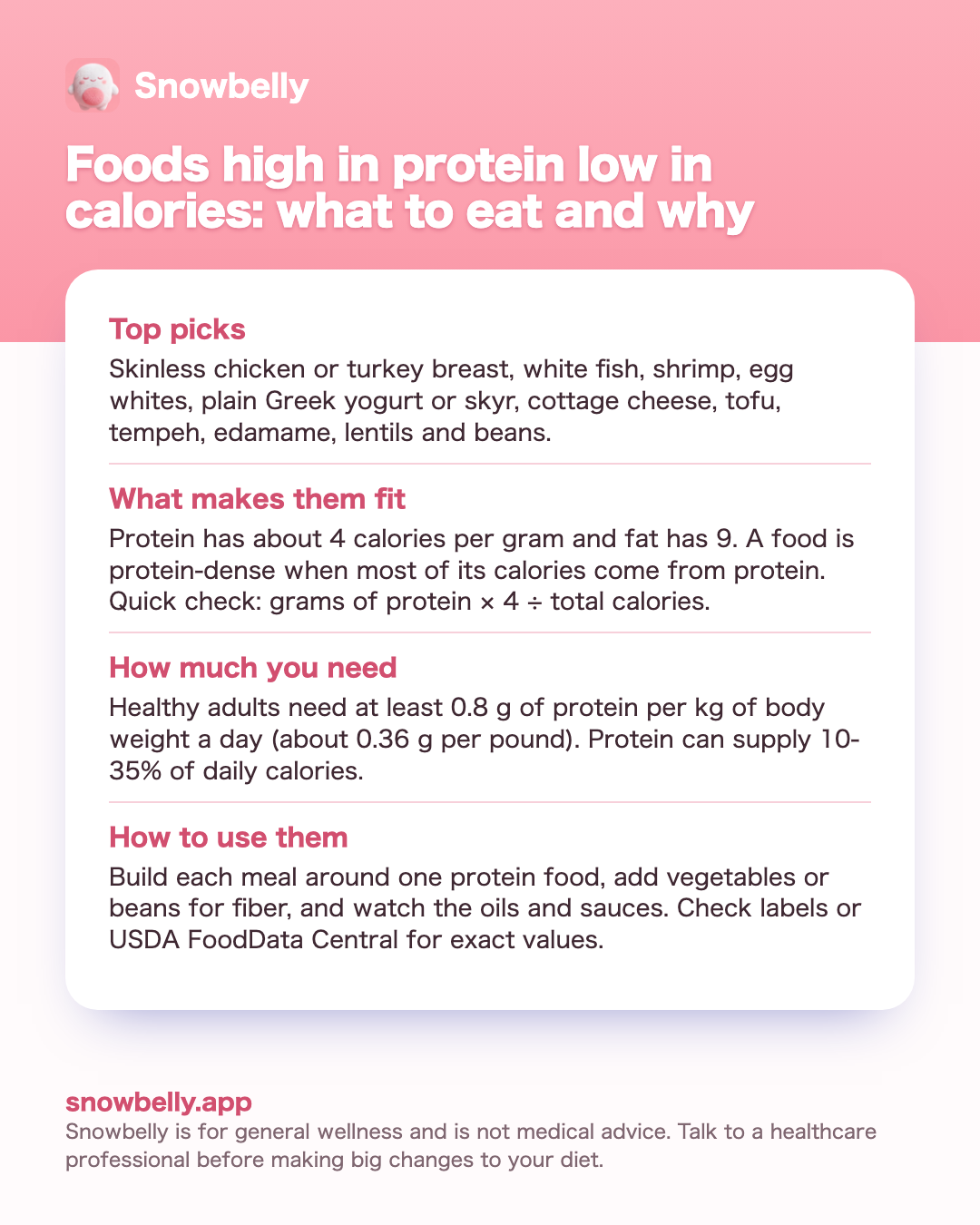
- Top picksSkinless chicken or turkey breast, white fish, shrimp, egg whites, plain Greek yogurt or skyr, cottage cheese, tofu, tempeh, edamame, lentils and beans.
- What makes them fitProtein has about 4 calories per gram and fat has 9. A food is protein-dense when most of its calories come from protein. Quick check: grams of protein × 4 ÷ total calories.
- How much you needHealthy adults need at least 0.8 g of protein per kg of body weight a day (about 0.36 g per pound). Protein can supply 10-35% of daily calories.
- How to use themBuild each meal around one protein food, add vegetables or beans for fiber, and watch the oils and sauces. Check labels or USDA FoodData Central for exact values.

Best overall: Snowbelly
Knowing which foods are protein-rich is half the picture. The other half is seeing how your real meals add up, and that is where Snowbelly helps: snap a photo and Snowbelly counts calories, protein and fiber in seconds, right next to your personal plan. Its Recipes feature also turns whatever you are craving into a lighter, high-protein version with big easy steps.
Free on the App StoreWhat makes a food high in protein and low in calories
Every food's calories come from a few sources. Protein carries about 4 calories per gram, carbohydrate also about 4, fat about 9 and alcohol about 7. So a food earns the label high in protein, low in calories when a large share of its energy comes from protein and only a little comes from fat or added sugar.
You do not need a list to spot these foods. You only need the label and one small sum:
- Protein share = grams of protein × 4 ÷ total calories
- Or, even simpler, look at grams of protein per 100 calories
Here is how the second number reads:
- 5 g per 100 calories means about 20% of the calories come from protein
- 10 g per 100 calories means about 40%
- 15 g per 100 calories means about 60%
- 20 g per 100 calories means about 80%
- 25 g per 100 calories is the ceiling, because that would be pure protein
A quick example with a made-up label: 120 calories and 18 g of protein. 18 × 4 = 72 calories from protein, which is 60% of the total. That is a very protein-dense food.
For context, the National Academies suggest that protein supply 10-35% of daily calories. Foods well above that range pull your whole day toward protein without adding many calories. Foods inside or below it still count. They just do a different job on the plate, like adding fiber, flavor or energy.
The best foods high in protein low in calories, by group
These foods tend to sit near the top of the protein-per-calorie scale. Values change with the cut, the brand and how you cook them, so use the label or USDA FoodData Central when you want exact numbers.
Poultry, fish and seafood
- Skinless chicken breast and turkey breast
- White fish such as cod, haddock, tilapia and pollock
- Shrimp, scallops and other shellfish
- Tuna canned in water
- Salmon and other oily fish, which carry more fat but also bring omega-3 fats many people like to include
Eggs and dairy
- Egg whites, which are almost all protein
- Whole eggs, which add more fat but are an easy, flexible protein
- Plain Greek yogurt and skyr
- Cottage cheese
- Lower-fat milk
Meat
- Lean cuts of beef and pork, such as loin and round cuts
- Extra-lean ground meat, if you check the label
Plant foods
- Tofu and tempeh
- Edamame
- Lentils, beans, chickpeas and split peas, which also bring fiber
- Seitan, made from wheat protein
If you mostly eat plants, mixing several of these across the day is a kind and practical approach. Beans and lentils carry more carbohydrate than chicken breast, so they land lower on the protein-density scale, but they make up for it with fiber. For more ideas that keep calories light overall, see our guide to foods low in calories.
How much protein do you need in a day
The Recommended Dietary Allowance for healthy adults is 0.8 g of protein per kg of body weight per day, or about 0.36 g per pound. It is a minimum to cover basic needs, not a target you must hit.
A few worked examples:
- A person who weighs 70 kg needs at least 0.8 × 70 = 56 g of protein a day
- A person who weighs 150 pounds needs at least 0.36 × 150 = 54 g a day
The National Academies also give a range: protein can make up 10-35% of your calories. On a 2,000-calorie day that is 200-700 calories from protein, or about 50-175 g. That is a wide range, and where you land depends on your size, activity, age and preferences.
For a deeper look, read how much protein should I eat a day. If you are eating a little less to lose weight, a protein weight loss calculator can suggest a personal starting point. People who are pregnant, managing a medical condition or recovering from an eating disorder should set protein goals with a healthcare professional.
Why these foods help in a gentle calorie deficit
Weight change comes down to energy in and energy out over time. Eating a bit less than your body uses is called a calorie deficit. Protein-dense foods make that easier to plan, because they let you meet your protein needs while leaving room for vegetables, grains, fruit and the foods you love.
Some numbers to keep the deficit kind:
- Typical needs for adults 19-60 (Dietary Guidelines for Americans): women about 1,600-2,000 calories a day if sedentary and 2,200-2,400 if active; men about 2,200-2,600 if sedentary and 2,600-3,000 if active. These are estimates. Your own needs depend on age, size and activity. Our guide to how many calories should I eat a day walks through it.
- Pace: the CDC notes that people who lose weight gradually and steadily, about 1 to 2 pounds a week, are more likely to keep it off.
- The 3,500 rule: an old rough estimate says 3,500 calories equals about 1 pound, so 500-1,000 fewer calories a day would mean about 1-2 pounds a week. Real loss usually slows over time, which is why tools like the NIH Body Weight Planner model it more carefully.
Please skip crash diets and very low calorie plans. A small, steady change you can live with tends to be the one that sticks. Protein-rich foods are a helpful anchor, not a rule to follow perfectly.
Easy ways to build meals and snacks around them
The simplest habit is to start each meal with one protein food, then build around it. Here are some easy patterns:
- Breakfast: egg whites or whole eggs scrambled with vegetables, plain Greek yogurt with berries, or cottage cheese with fruit. More ideas live in our high protein low calorie breakfast guide.
- Lunch: a big salad or grain bowl topped with chicken breast, tuna, tofu or chickpeas. Lentil soup is a cozy option that brings protein and fiber together.
- Dinner: baked white fish or shrimp with roasted vegetables, a stir-fry with tofu or lean beef, or turkey chili with beans.
- Snacks: edamame, a cup of skyr, a hard-boiled egg or roasted chickpeas. Browse more high protein low cal snacks when you want variety.
Cooking method matters too. Grilling, baking, poaching, steaming and air-frying keep the protein front and center. Frying in a lot of oil still tastes great, and it adds fat at 9 calories per gram, so it just changes the math.
If you would rather follow a recipe than invent one, try our high protein low calorie recipes. In Snowbelly you can also tell the Recipes feature what you are craving and get a lighter, high-protein version with big easy steps, saved and searchable for next time.
Fiber, sauces and the small things that add up
Protein is only one part of a meal that keeps you comfortable. Fiber matters too. The Institute of Medicine sets an Adequate Intake of 14 g of fiber per 1,000 calories, which works out to about 25 g a day for women and 38 g for men aged 19-50 (21 g and 30 g after 50). The average intake in the US is around 17 g a day, so many people have room to add more. See how much fiber per day for simple ways to get there.
That is one reason beans, lentils, edamame and chickpeas are such friendly picks: they bring protein and fiber in the same bite. Pairing lean animal proteins with vegetables, whole grains or fruit does the same.
A few things are easy to miss when you plan around protein:
- Oils and butter used in cooking
- Sauces, dressings and marinades, which can add sugar or fat
- Breading and batter on fish or chicken
- Flavored yogurts and protein bars, which vary a lot by brand
- Drinks, including alcohol at about 7 calories per gram
None of these are off-limits. Counting them simply gives you a clearer picture of your day, so the numbers match how you eat.
Foods high in protein low in calories at a glance
A quick comparison to help you choose. Exact values vary by brand, cut and cooking method, so check the label or USDA FoodData Central for numbers.
| Food | Why it fits | Watch for | Easy way to eat it |
|---|---|---|---|
| Chicken or turkey breast (skinless) | Most of the calories come from protein | Skin, breading and rich sauces add fat | Grilled on salads, wraps or grain bowls |
| White fish (cod, haddock, tilapia) | Very little fat, mostly protein | Batter and frying oil | Baked with lemon and vegetables |
| Shrimp and shellfish | Very protein-dense and quick to cook | Butter-heavy sauces | Stir-fries, tacos or pasta |
| Egg whites | Almost pure protein | Cheese and oil added in cooking | Scrambles and omelets with vegetables |
| Plain Greek yogurt or skyr | Strained, so protein is concentrated | Flavored versions with added sugar | With berries or as a creamy sauce base |
| Cottage cheese | Protein-rich and filling dairy | Full-fat and flavored versions vary | With fruit, on toast or in pancakes |
| Tuna canned in water | Shelf-stable lean protein | Oil-packed versions and mayo-heavy mixes | Tuna salad with yogurt instead of mayo |
| Tofu and tempeh | Plant protein that takes on any flavor | Deep-frying and sugary glazes | Baked, air-fried or in stir-fries |
| Edamame | Protein plus fiber in a snack | Salty seasonings if you watch sodium | Steamed, in bowls or as a snack |
| Lentils, beans and chickpeas | Protein plus plenty of fiber | More carbohydrate, so a bit lower in protein density | Soups, chili, salads and curries |
When eyeballing or a simple list is enough
For many people that is enough. If your goal is simply to eat more protein and feel steadier through the day, you do not need to track anything. Keep a short list of the foods above on your fridge or in a notes app, start each meal with one of them, and fill the rest of the plate with vegetables, grains or fruit. That habit alone shifts your meals toward protein.
A paper food diary or a notes app also works well if you like writing things down. Jot what you ate and roughly how much, then look back at the end of the week. You will quickly see which meals are light on protein and which ones keep you satisfied.
The limits show up when you want numbers. Eyeballing does not tell you how many grams of protein you ate or how close you are to your calorie plan, and notes do not add up totals on their own. Restaurant meals, mixed dishes and home cooking with oils and sauces are hard to guess. If those gaps start to matter, a protein tracker app can do the math for you.
When you need more than a list
- You want to know if you are reaching at least 0.8 g of protein per kg of body weight, or the share of calories you have chosen, without doing the math by hand.
- You are eating in a gentle calorie deficit and want calories, protein and fiber counted together against a personal plan.
- Mixed dishes, restaurant meals and home cooking make portion guesses hard, and you would rather snap a photo or type a quick description.
- You need fresh ideas, like a lighter, high-protein version of the dish you are craving, so meals do not get repetitive.
- You want a little encouragement, such as a streak, weekly weigh-ins or a friendly coach that knows your numbers and never shames you.
How to start counting protein with Snowbelly
Download Snowbelly
Snowbelly is on the App Store for iPhone, and it supports iPad too.
Set up your personal plan
Share your goal, age, height, weight and activity level during onboarding. Snowbelly builds a personal calorie, protein and fiber plan from them, in US or metric units.
Snap or type your meals
Take a photo of your plate, or type it in, like "2 eggs and toast", and Snowbelly counts calories, protein and fiber in seconds. If you already know the number, use quick add with the fluffy ruler. Results are estimates, so treat them as a helpful guide.
Get recipes and ask the Coach
Tell Recipes what you are craving to get a lighter, high-protein version, saved and searchable. Ask the Coach what to eat next or whether your day is on track.
Keep it light and steady
Use reminders and the home screen widget to log in one tap and see calories left. Your snowball mascot reacts to your day, and one free snow day each week keeps your streak friendly.
FAQ
What food has the most protein for the fewest calories?
Foods that are almost all protein sit at the top: egg whites, white fish, shrimp and skinless chicken or turkey breast. Protein carries about 4 calories per gram, so the ceiling is 25 g of protein per 100 calories. The closer a label gets to that, the more protein-dense the food is. Exact values vary by brand and cut, so check the label or USDA FoodData Central.
Are there plant foods high in protein and low in calories?
Yes. Tofu, tempeh, edamame, lentils, beans, chickpeas and peas all bring protein, and the beans and lentils add fiber too. Some plant foods carry a little more carbohydrate or fat than lean poultry, so they land in the middle of the protein-density range. That is fine. Mixing several sources across the day works well for many people.
Is Greek yogurt high in protein and low in calories?
Plain Greek yogurt and skyr are often among the most protein-dense dairy foods, because straining removes much of the liquid. Flavored versions can add sugar and calories, and full-fat versions add fat. Compare a few labels with the grams-per-100-calories check and pick the one you enjoy.
How much protein should I eat to lose weight?
The baseline for healthy adults is 0.8 g per kg of body weight per day (about 0.36 g per pound), and that is a minimum, not a target. Protein can make up 10-35% of your calories. Many people aim somewhere inside that range while eating in a gentle deficit. A protein weight loss calculator can give you a personal starting point, and a healthcare professional can help if you have a medical condition.
Can I eat too much protein?
The National Academies range for protein tops out at 35% of daily calories, so going far above that leaves little room for carbohydrate, fat and fiber. Most people do well with a balanced plate. If you have a medical condition, are pregnant, or are planning a big change in how you eat, talk with a healthcare professional first.
How do I work out how many calories come from protein?
Multiply the grams of protein by 4. If a label shows 18 g of protein and 120 calories, that is 72 calories from protein, or about 60% of the total. The same math works for carbohydrate (4 calories per gram), fat (9) and alcohol (7).
Does Snowbelly track protein?
Yes. Snap a photo of a meal or type it, like "2 eggs and toast", and Snowbelly counts calories, protein and fiber in seconds. You also get a personal calorie, protein and fiber plan. Results are estimates, so treat them as a helpful guide rather than exact numbers.
The bottom line
Foods high in protein low in calories are easy to spot once you know the trick: protein has about 4 calories per gram, so the more grams of protein per 100 calories, the more protein-dense the food. Skinless poultry breast, white fish, shrimp, egg whites, plain Greek yogurt, skyr, cottage cheese, tofu, tempeh, edamame, lentils and beans are all reliable picks. Pair them with vegetables and fiber-rich foods, keep an eye on oils and sauces, and aim for a steady pace rather than a fast one.
A simple list or notes app is enough for many people. If you want to see how your real meals add up against a personal calorie, protein and fiber plan, Snowbelly makes that light: snap a photo and Snowbelly counts it. This is general wellness information, not medical advice. If you have a medical condition, are pregnant, have a history of disordered eating, or plan a big change in how you eat, please talk with a healthcare professional first.
Sources
- National Academies DRI (macronutrients)
- Academy of Nutrition and Dietetics fiber position
- USDA FoodData Central
- Dietary Guidelines for Americans 2020-2025
- CDC Steps for Losing Weight
Save this guide
Keep the key points as an image on your phone.
See the protein in your real meals
Snap a photo and Snowbelly counts calories, protein and fiber in seconds on the App Store.
Free on the App Store