Snowbelly

Quick answer
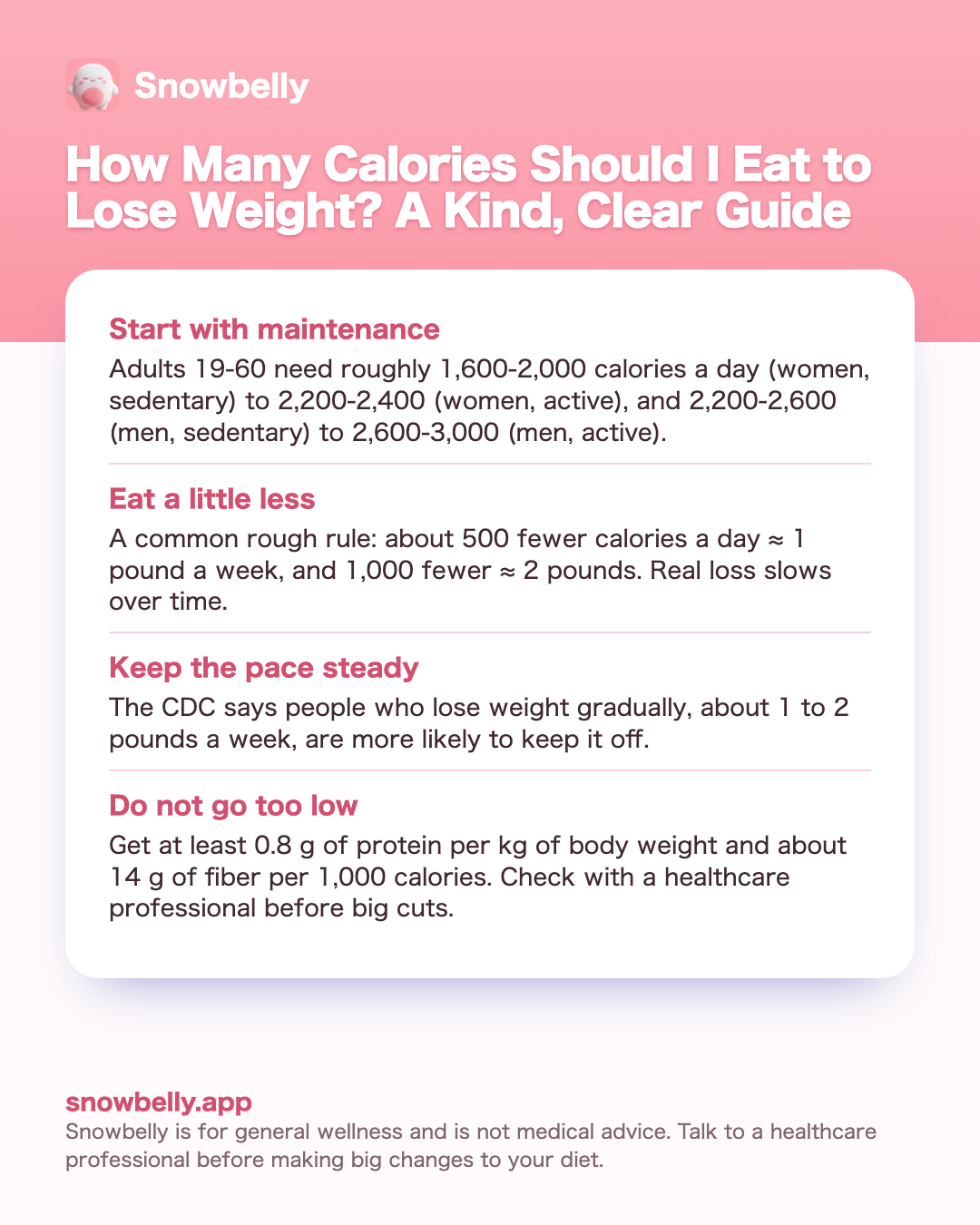
- Start with maintenanceAdults 19-60 need roughly 1,600-2,000 calories a day (women, sedentary) to 2,200-2,400 (women, active), and 2,200-2,600 (men, sedentary) to 2,600-3,000 (men, active).
- Eat a little lessA common rough rule: about 500 fewer calories a day ≈ 1 pound a week, and 1,000 fewer ≈ 2 pounds. Real loss slows over time.
- Keep the pace steadyThe CDC says people who lose weight gradually, about 1 to 2 pounds a week, are more likely to keep it off.
- Do not go too lowGet at least 0.8 g of protein per kg of body weight and about 14 g of fiber per 1,000 calories. Check with a healthcare professional before big cuts.

Best overall: Snowbelly
Snowbelly turns this question into a personal answer. During setup it builds your own calorie, protein and fiber plan from your goal, age, height, weight and activity, then you snap a photo of each meal and Snowbelly counts calories, protein and fiber in seconds. Weekly weigh-ins show how your number is working, and it is free on the App Store.
Free on the App StoreStep 1: Find your maintenance calories
Your maintenance calories are what your body uses in a normal day to keep your weight steady. Every weight loss number starts here, so it is worth a few minutes. If you want the longer version, our guide to maintenance calories goes deeper.
The Dietary Guidelines for Americans give rough daily needs for adults aged 19 to 60:
- Women: about 1,600-2,000 calories if sedentary, 2,200-2,400 if active
- Men: about 2,200-2,600 calories if sedentary, 2,600-3,000 if active
These are estimates. Your own needs move with age, body size and how much you move. Shorter, older and less active people tend to sit near the low end. Taller, younger and more active people tend to sit near the high end.
For a more personal number, most calculators use the Mifflin-St Jeor equation from 1990. It estimates resting energy, the calories you burn at rest:
- 10 × weight in kg
- plus 6.25 × height in cm
- minus 5 × age in years
- then add 5 for men, or subtract 161 for women
The formula was built from 498 healthy adults aged 19 to 78. To get from resting energy to a full day, calculators multiply by an activity factor, from about 1.2 for sedentary up to 1.9 for very active. Those multipliers are a common calculator convention, not part of the original paper, so treat the result as a starting guess. A BMR calculator does the math for you.
Two worked examples:
- A 35-year-old woman, 165 cm and 70 kg: 700 + 1,031 − 175 − 161 ≈ 1,395 calories at rest. At a sedentary 1.2, that is about 1,675 a day.
- A 30-year-old man, 180 cm and 90 kg: 900 + 1,125 − 150 + 5 = 1,880 calories at rest. At 1.2, that is about 2,255 a day.
Both land inside the Dietary Guidelines ranges for sedentary adults, which is a nice sanity check. If your own result looks very different from the ranges, double-check your units and activity level.
Step 2: Choose a gentle calorie deficit
Weight loss happens when you eat a little less than your maintenance number over time. A common rough rule says about 3,500 calories equals one pound of body weight. Spread over a week, that works out to:
- 500 fewer calories a day ≈ about 1 pound a week
- 1,000 fewer calories a day ≈ about 2 pounds a week
It is a handy starting point, but it is only a rough estimate from older CDC material. Real loss tends to slow over time, because a smaller body needs fewer calories than it did at the start. The NIH Body Weight Planner models this slowdown if you want a more realistic curve. A calorie deficit calculator can also help you try a few options side by side.
Back to our examples:
- The man at about 2,255 a day could eat around 1,755 for roughly a pound a week. That still leaves plenty of room for satisfying meals.
- The woman at about 1,675 a day would land near 1,175 with a full 500 deficit. That is quite low for daily life. A smaller cut of 250 to 300 calories, plus a daily walk, may feel kinder and be easier to keep up. Before eating that little, it is wise to check with a healthcare professional.
Smaller deficits still count. They often fit better with work, family and sleep. A pace you can hold for months beats a fast start you drop after two weeks.
A few signs your deficit may be too big:
- You feel hungry most of the day and night
- Your energy, sleep or workouts drop off
- You find it hard to reach your protein and fiber targets
- You keep swinging between very strict days and very stuffed days
If that sounds familiar, nudge your calories up a little and see how the next week feels.
How fast should you lose weight?
The CDC notes that people who lose weight gradually and steadily, about 1 to 2 pounds a week, are more likely to keep it off. That is a helpful guardrail when you pick your number.
What that looks like in practice:
- Week to week: expect some bounce. Daily scale numbers move up and down for many reasons, so a weekly weigh-in tells a calmer story than a daily one.
- Month to month: at 1 to 2 pounds a week, a month adds up to roughly 4 to 8 pounds. Slower months are normal.
- Over time: as you lose weight, your maintenance number drifts down. A deficit that worked at the start may shrink without you changing anything.
When progress stalls for a few weeks, it is often a weight loss plateau rather than something you did wrong. Recalculating your maintenance at your new weight, checking portions for a week, or adding a little more movement can help.
It also helps to measure progress in more than one way. How your clothes fit, how you sleep, how much energy you have and how calm you feel around food all count. The scale is one helpful signal, not the whole picture.
What to eat inside your calories: protein and fiber
Your calorie number tells you how much. What you eat inside it shapes how full and steady you feel. Two nutrients are worth watching closely: protein and fiber.
Protein. The National Academies set the protein RDA at 0.8 g per kg of body weight per day for healthy adults, about 0.36 g per pound. That is a minimum, not a target. The acceptable range is 10-35% of your calories. For the 70 kg woman above, the minimum is about 56 g a day. You can eat more than the minimum, as long as you stay within that range. Our guide on how much protein should I eat a day walks through the options.
Fiber. The Institute of Medicine suggests 14 g of fiber for every 1,000 calories. That works out to about 25 g a day for women and 38 g for men aged 19 to 50, and 21 g and 30 g after 50. The average American eats about 17 g a day, so most of us have room to grow. Beans, vegetables, fruit and whole grains are easy places to find it. See how much fiber per day for simple ways to add more.
Where calories come from. Each gram of protein and carbohydrate has about 4 calories. Fat has about 9, and alcohol about 7. That is why a generous pour of oil or a couple of drinks can add up quickly, while a big bowl of vegetables barely moves the total. No food is off limits. It simply helps to know where your calories come from.
A simple plate for most meals:
- a palm or two of protein
- half a plate of vegetables or fruit
- a portion of whole grains or starchy foods you enjoy
For exact calorie values of specific foods, USDA FoodData Central is the official reference.
Who might need a different number
The ranges above fit many healthy adults. Some people need a different approach, or extra support.
Very active people. Exercise raises your daily needs. The 2024 Adult Compendium of Physical Activities lists walking at 2.8-3.4 mph at 3.8 METs and running at 6 mph at 9.3 METs. A standard formula turns that into calories: MET × 3.5 × weight in kg ÷ 200 per minute. For a 70 kg person, a 30-minute walk at about 3 mph burns roughly 140 calories. Try the walking calories calculator with your own numbers, and treat exercise estimates as rough, since bodies differ.
Older adults. The Mifflin-St Jeor formula lowers resting energy by 5 calories for each year of age, so needs often drift down over time. Fiber needs also shift after 50.
Women with PCOS. PCOS affects about 1 in 10 women of childbearing age, and many have overweight or obesity. The Office on Women's Health notes that even a 10% loss in body weight, such as 15 pounds for a 150-pound woman, can make the menstrual cycle more regular, and losing weight may improve how the body uses insulin. PCOS is diagnosed and treated by a doctor, so plan your calories with yours. More in lose weight with PCOS.
Perimenopause. Perimenopause usually begins in the mid- to late 40s and lasts about 4 years on average. Hormone changes can affect sleep, mood and weight, and can make weight gain more likely. See perimenopause weight loss for gentle ideas.
Talk to a healthcare professional first if you:
- are pregnant or breastfeeding
- have diabetes, heart or kidney disease, or another medical condition
- take medicine that affects appetite or weight
- have a history of an eating disorder, or counting feels stressful
- want to make a big change to how you eat
Turning your number into everyday meals
A calorie target only helps if you can see roughly where you stand. That is where tracking comes in. You do not need to be perfect. You need to be close enough, most days.
A few habits make it easier:
- Log as you go. Noting meals right after eating is easier than remembering them at night.
- Use estimates kindly. Every calorie count, from a label, a calculator or an app, is an estimate. Aim for consistent, not exact.
- Plan around your favorites. If you love a weekend brunch, keep room for it. Foods you enjoy belong in the plan.
- Notice patterns, not single days. One stuffed evening does not undo a steady week.
Photo logging has made this much quicker. With a picture calorie counter like Snowbelly, you snap a photo of your meal and Snowbelly counts calories, protein and fiber in seconds. You can also type it, like 2 eggs and toast, or use quick add with the fluffy ruler when you already know the number. Results are estimates, so a quick glance at portions is still worth it.
Snowbelly also builds your personal calorie, protein and fiber plan during setup, from your goal, age, height, weight and activity. Your snowball mascot reacts to your day: happy when you eat well, stuffed after a big feast, and sleepy if you forget to log. It keeps things light, which helps on days when motivation is low.
Calorie deficit sizes and rough weekly pace
The 3,500-calories-per-pound rule is rough, but it helps you see how deficit size and pace connect. Pick the smallest deficit that still feels like progress.
| Daily deficit | Rough weekly pace | May suit | Keep in mind |
|---|---|---|---|
| About 250 calories | About 0.5 lb | Smaller or less active bodies, or the last few pounds | Slow, but easy to fit into daily life |
| About 500 calories | About 1 lb | Many adults as a first step | The classic starting point for a gentle pace |
| About 750 calories | About 1.5 lb | People with higher maintenance needs | Watch hunger, sleep and energy |
| About 1,000 calories | About 2 lb | Larger or very active people | Upper end of the CDC pace; talk to a healthcare professional first |
When eyeballing or a notes app is enough
If you already cook most meals, eat similar things each week, and just want a rough sense of where you stand, a free approach can work well, and for many people that is enough:
- Eyeballing portions: use your hand as a guide, fill half the plate with vegetables, and see how you feel after a few weeks.
- A notes app: jot down meals and rough numbers from food labels or USDA FoodData Central.
- A paper food diary: some people find writing by hand slows them down in a helpful way.
Pair any of these with a one-time calculation of your maintenance calories and a weekly weigh-in, and you have a solid plan. The limits show up over time. Looking up every food takes effort, protein and fiber are easy to lose track of, and a notes app will not tell you how your week is going or nudge you when you forget.
When you might want more help
- You keep losing track of meals by the afternoon and want logging that takes seconds, like snapping a photo.
- You want to see protein and fiber next to calories, not just one number.
- You eat out or eat varied meals often, so looking up every food feels slow.
- You do better with gentle reminders, a streak or a cheerful nudge than a blank page.
- You want weekly weigh-ins and progress toward your goal weight in one place.
How to start counting with Snowbelly
Download Snowbelly
Snowbelly is on the App Store for iPhone. Open it and meet your snowball.
Set up your plan
Enter your goal, age, height, weight and activity. Snowbelly builds a personal calorie, protein and fiber plan from them, in US or metric units.
Log meals your way
Snap a photo and Snowbelly counts it, type it in plain words, or use quick add with the fluffy ruler when you already know the number.
Check in and adjust
Weigh in weekly, ask the coach if your day is on track, and use the home screen widget to see calories left at a glance.
FAQ
How many calories should I eat to lose 1 pound a week?
By the common 3,500-calorie rule, about 500 fewer than your maintenance calories each day. If your maintenance is about 2,200, that means roughly 1,700 a day. It is a rough estimate, and loss usually slows a little over time as your body gets smaller.
How many calories should I eat to lose 2 pounds a week?
About 1,000 fewer than maintenance by the same rough rule. That is the upper end of the 1 to 2 pounds a week the CDC links with keeping weight off. It tends to suit people with higher maintenance needs better than smaller or less active people. Check with a healthcare professional before a cut that large.
Do women need fewer calories than men to lose weight?
Often, yes, because estimated needs differ. The Dietary Guidelines put sedentary women at about 1,600-2,000 calories a day and sedentary men at about 2,200-2,600. A smaller starting number means a smaller deficit may fit better. Your own size, age and activity matter more than any average.
Why am I not losing weight on a calorie deficit?
Calorie needs and food counts are both estimates, so a small gap can quietly disappear. As you lose weight, your maintenance number also drops, which shrinks the deficit. Try recalculating at your current weight, checking portions for a week, and looking at weekly averages rather than single days. If nothing changes for a long time, a healthcare professional can help look for other causes.
Should I eat back the calories I burn exercising?
Exercise burn numbers are rough. They come from MET values and body weight, and bodies differ. One gentle approach is to eat back part of it on very active days, especially if you feel tired or very hungry. Watch your weekly trend and adjust from there.
How much protein should I eat while losing weight?
The RDA for healthy adults is 0.8 g per kg of body weight a day, about 0.36 g per pound. That is a minimum, not a target. Protein can make up anywhere from 10-35% of your calories, so there is room to eat more within your calorie goal.
Can I eat too few calories?
Yes. Very low intakes are hard to keep up, can leave you tired and hungry, and make it harder to get enough protein and fiber. A steady pace of about 1 to 2 pounds a week is more likely to last. If you are thinking about eating very little, or you have a medical condition, talk to a healthcare professional first.
The bottom line
For most adults, the answer starts with maintenance calories, roughly 1,600-2,400 a day for women and 2,200-3,000 for men depending on activity, then a gentle deficit of about 250 to 1,000 calories a day. Aim for a pace near 1 to 2 pounds a week, keep protein and fiber in view, and recalculate as your body changes.
You can do all of this with a calculator and a notes app, and for many people that is enough. If you want counting to feel quicker and kinder, Snowbelly builds your plan, counts a meal from a photo, and keeps your weekly progress in one place. This is general wellness information, not medical advice.
Sources
- Dietary Guidelines for Americans 2020-2025
- Mifflin-St Jeor 1990
- CDC Steps for Losing Weight
- National Academies DRI (macronutrients)
- Academy of Nutrition and Dietetics fiber position
Save this guide
Keep the key points as an image on your phone.
Find your number and start gently
Snowbelly builds your personal calorie, protein and fiber plan in a few taps on the App Store.
Free on the App Store